OCCUPY ROME BCE: How Class War ended Western Civilization’s First Republic

‘In a rich man’s house, there is no place to spit but his face’
Diogenes of Sinope, 404 BCE to 323 BCE

I

Wild Beasts

It is the year 134 BCE. A great public assembly is gathered on the Capitoline Hill in the centre of Rome. A thirty year old politician, Tiberius Gracchus, adjusts his trademark black robes, strides up to the large speakers platform in front of the temple of Jupiter and addresses the immense throng. It takes him no time to silence the crowd, as many of them have travelled for weeks from distant parts of Italy just to hear him speak. He does not know it, but he will go onto deliver a speech which would seal both his fate, and shake the very foundations of the Roman republic.
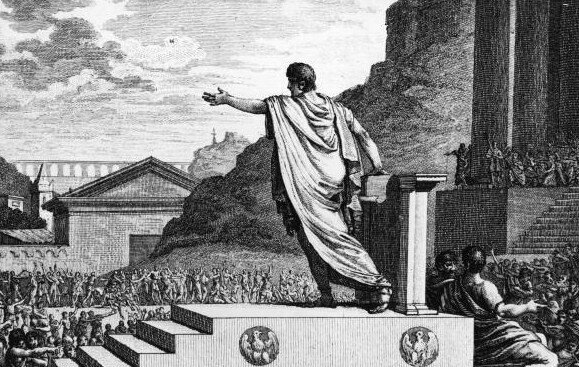
The ‘plebeian’ or peoples assembly, Silvestre David Mirys (1742-1810)

In his calm, deliberate manner, Tiberius delivered a blistering attack on the Senate, the main legislative body of the Republic and the seat of all power in Rome. He knew his subject well – he, Tiberius Gracchus, was after all one of the two people elected as the ordinary citizens representatives to the Senate – a ‘tribune’ of the non noble class known as the plebeians,or the ‘plebs’. Tiberius speaks of the age of heroes five centuries ago, when their ancestors, alone amongst all the peoples of the world, had done away with kings forever, and had taken a sacred vow that in Rome, only ‘the people’ would rule. Rome had gone in that time from a small village to masters not only of Italy, but of unheard of kingdoms in Africa and Asia. All of that wealth and land had not however gone to the people but into the personal fortunes of the immensely wealthy noble families who made up the Senate

These Senators had not just appropriated for their private fortunes all the wealth from Rome’s endless foreign wars, paid for with plebeian blood. They had used the newly acquired money to buy up all the farming land in Italy, dispossessing en masse the citizen-farmers that had always been the backbone of the Roman republic. The situation had been summed up well by the recently deceased senator Cato the Elder: “Thieves of private property pass their lives in chains; thieves of public property in riches and luxury”

It was in this context that Tiberius Gracchus spoke the words by which he would be immortalised

‘The wild beasts that roam over Italy have every one of them a cave or lair to lurk in…While the men who fight and die for Italy enjoy the common air and light and nothing else. Houseless and homeless they wander about with their wives and children..they fight and die to support others in wealth and luxury..though as Romans they are styled as Masters of the World, they have not a single clod of earth to call their own‘.

The conflict being described by Tiberius would dominate the next one hundred years of the Roman Republic. It would end with the fall of the Republic and the birth of the Empire, where decisions would no longer be made by an elected Senate but by one man, the Emperor. Under its Emperors Rome would grow more powerful than ever and endure for centuries. However it came at a great cost -for the like of the Republic would not be seen again in Western Europe until the great democratic revolutions of the seventeenth and eighteenth centuries, nearly two millenia later. The French, British and American anti-monarchists would explicitly model their new ‘republics’ on the lost republic of ancient Rome. Even the word republic was taken from this period (the Latin res publica, ‘our public thing’). Insomuch as the French, British and the Americans would then go onto impose their models of governance on the whole world, the story of the collapse of the original republic and the populism that bought about its end seems timely, even with all the caveats about comparing different historical eras.

After whipping the crowd up into a frenzy with his ‘Wild beasts of Italy’ speech, Tiberius Gracchus delivered his coup de grace. He introduced a bill called the Lex Agraria. The bill stipulated that henceforth, there would be an upper limit on the amount of land a single man could own – anything in excess of it would be become public land and be redistributed to landless citizens. Crucially the bill also said that any land which Rome acquired in her overseas adventures would not go up for sale to the highest bidder but be redistributed to the public as farming lands .

Tiberius told the crowd gathered on the Capitoline Hill how he had of course initially pursued his bill through the normal channels, and had introduced it in the Senate. He told them how the men of the Senate had reacted as rich men have always done when confronted with wealth redistribution. He, the tribune of the plebs, their sacred representative, had been laughed out of the chamber. However, Tiberius declared triumphantly, they did not need the Senate. According to laws unused for centuries a people’s assembly had the power to pass laws without the agreement of those corrupt old men – they could, right now, vote on this bill, and sieze control of their own destinies. To the roars of the audience, he proposed to put the vote to them, the ordinary men of Rome.

This was all too much for one man. Marcus Octavius, the other tribune of the plebeians and Gracchus’s co-leader of the assembly. was every bit a creature of the Senate. He stood up and imperiously shouted ‘veto’ (Latin for ‘I forbid’). It was all Tiberius could do to keep the furious mob from tearing Octavius apart, until his bodyguard were able to push their way through the crowd and shepherd Octavius to safety.
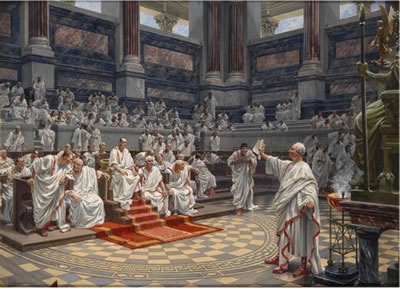
The Senate

The Senate was horrified to hear of these developments. The once powerful plebeian assemblies had long been subordinatedto them, and by centuries of custom prevented from introducing any bill without the Senates’ prior approval. They commanded Octavius to ensure the bill never became law, and Octavius vetoed every vote on land redistribution that followed in the peoples’ assemblies.

Tiberius finally put it to the assembly that if Octavius would not let them vote on the redistribution bill, then they could vote to remove Octavius from his role as their tribune. This was at the time, unthinkable – the power sharing arrangement between Tiberius and Octavius was one that mirrored at every level in the Roman Republic and was fundamental to it. The way the Romans had protected their democratic traditions in an age of universal autocracy was an almost fanatical adherence to the principle that no single person was allowed to hold too much power. The head of the Republic was the Consul, but even this office was shared by two people, who alternated supreme power every month. This small measure of power was further diluted by laws stating that Consuls, like Tribunes and indeed anyone elected to any senior office in Rome, could only serve in their post for a single year, after which fresh elections were required to be held. The person who had just served in the post could not run for re-election in the same post for at least ten years. These traditions had been preserved without exception for the five hundred years since the overthrow of the last king of Rome. So great was the aversion to kings that it was legal for any citizen to kill, at any time and without reprisal, any other citizen they could prove had sought kingly power.

The people were pissed, however, and the vote to remove Octavius as co-tribune was unanimous. Now sole tribune of the plebs, Tiberius pushed the vote on land redistribution and the Lex Agraria became law. It was Tiberius Gracchus’s finest hour, but he succeeded also in completely alienating the Senate. Even the few reformist backers he had in the Senate abandoned him for his transgression of the Republic’s sacred laws, including his own uncle, the famed Scipio Amelianus, conqueror of Carthage. The Senate still controlled the purse-strings of the government and dominated the judiciary, and went out of their way to make sure that Gracchus’s redistribution laws were not enforceable in practice. Their strategy was to wait out Tiberius’s year as tribune, and once he stepped down, to replace him with a more traditionally pliant tribune of the plebs who would allow this whole thing to die. Tiberius Gracchus however would not be outmanoeuvred. Surrounded by thousands of armed supporters from the lower rungs of society, he made a shocking announcement. He would run for an unheard of second term. The announcement was greeted with jubilation by the plebeian assemblies.

This was too much for the Senate. The Chief High Priest, the Pontifex Maximus of Rome, a senator named Nasica, accused Tiberius of conspiring to make himself king. Nasica rose in the Senate on the day of the controversial election and declared ‘Let those who would save our country follow me’.

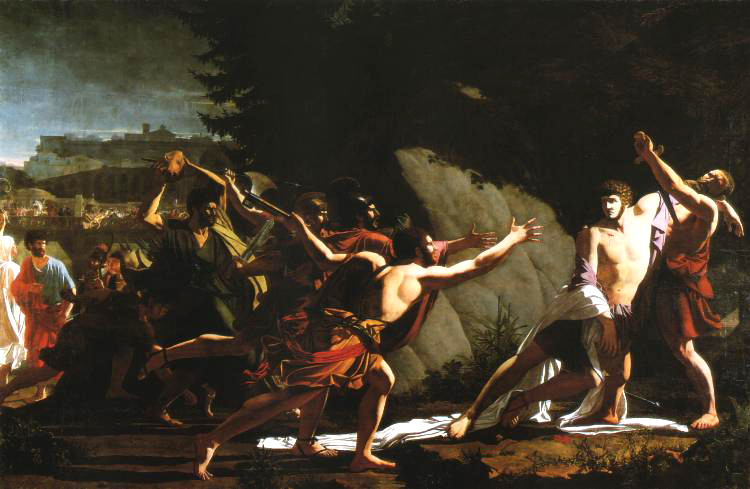
Nasica then led a mob of like minded senators to the Capitoline Hill where Tiberius Gracchus was giving a speech in front of his supporters. At Nasica’s command, they descended on the Gracchans and began beating them mercilessly. Finally, they found Tiberius and clubbed him to death on the steps of the Temple of Jupiter in broad daylight, even though as tribune, his body was supposedly sacrosanct. At the end of the day about three hundred people lay dead. All of the bodies, including Tiberius’s, were unceremoniously dumped in the Tiber.
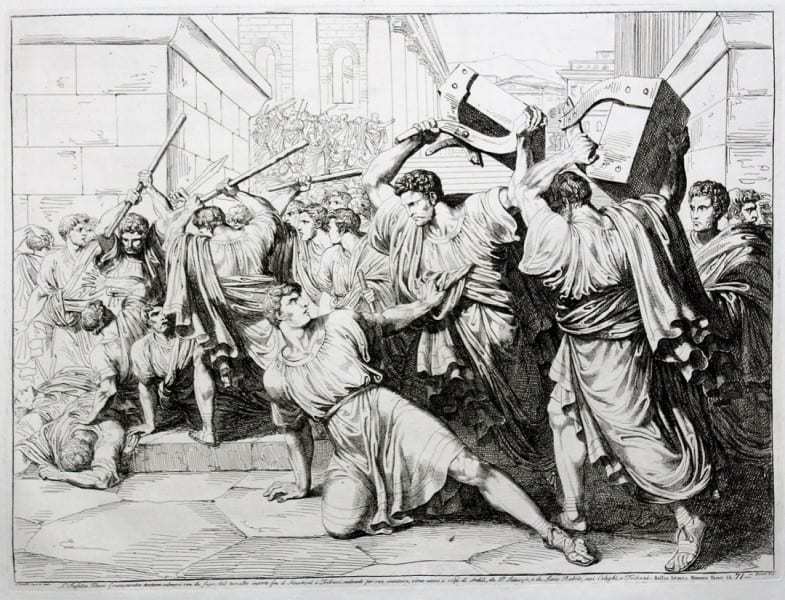
The Death of Tiberius Gracchus

The Senate then set up an extraordinary tribunal to investigate those responsible for the massacre, but the hundreds sentenced by the tribunal were to a to a man low class plebs who had supported Tiberius Gracchus – not a single senator was prosecuted. To make matters worse, Nasica, who had arranged the sacrilegious murder of the tribune of the plebs, openly walked around in his priestly robes, a free man.

The Senate did not care. They were complacent in the knowledge that they had crushed Tiberius’s rebellion. They did not know that a storm was coming – a gathering black cloud of vengeance in the form of Tiberius’s younger brother, Gaius Gracchus.

II

Gaius Gracchus
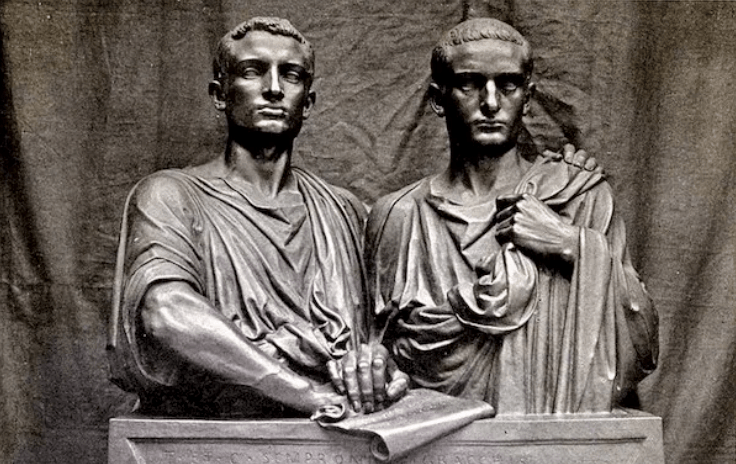
The Gracchi brothers, sculpture by Jean-Baptiste Claude Eugène Guillaume [Public domain], via Wikimedia Commons


While Tiberius had been politicking, the young Gaius had been away doing military service in Spain. Returning to Rome the year after his brother’s very public murder, Gaius found himself at the age of twenty two the inheritor of a whole movement. Plutarch says that Gaius was in every way the opposite of his brother. Where Tiberius was calm and dignified, and austere in his personal life, Gaius was passionate and hot headed, with ‘a love for ostentation’. Yet, in oratory, he found himself every bit his brother’s match, inventing a much imitated theatrical form in which he would pace the rostra energetically, gesturing and pulling his toga off his chest as he spoke. The myth of his brother proved a potent source of inspiration for his rabble rousing speeches against the Senate:

Before your eyes, these men beat Tiberius to death with clubs, and dragged his body from the Capitol though the midst of the city to be dumped into the Tiber. ..Those of his friends who were caught were put to death without trial”

Along with land redistribution, Gauis added two key new demands to Tiberius’s radical reforms. The first was extension of Roman citizenship to all Italians. Rome was by now the supreme power in Italy, but her jealously guarded democratic traditions, which included not just the right to vote but a whole package of basic civil liberties, were restricted only to a small group of residents of the city of Rome. The Senate watched helplessly as once loyal Italian allied cities across the peninsula exploded with violent demonstrations for equal rights. This also gave Gaius an immense base of popular support which dwarfed even that of Tiberius. The second new demand was the creation of a grain dole for poor citizens, gaining him support among non-voting urban poor. Together with his brothers supporters, this was all the coalition he needed to win the fiercely contested elections for the new tribune of the plebs, despite open hostility from the Senate.

The plebeian assemblies under Gaius became a hotbed of radical politics- and even some on the Senate began to come around. The supporters of these new policies became known as the ‘populares‘ – literally, the populists – while the traditionalists in the Senate came to be known as the ‘optimates’ – the ‘best’, or ‘the elites’.

The influence of the populares under Gaius was such that one of their own was elected Consul, the highest office of the Republic – a family friend of Gaius named Flaccus. Through Flaccus, Gaius was able to revenge himself on his brothers’ killers. The High Priest Nasica was finally convicted of Tiberius’s murder and exiled from Rome, never to return. Octavius, who had done so much to block Tiberius’s reforms, was barred from ever standing from political office. High ranking conservative Senators suddenly found themselves the subject of corruption and bribery investigations.

Secure in his untouchability, Gaius Gracchus announced that he would now do the very thing that had killed this brother. Thumbing his nose at the laws of the Republic, he campaigned for and effortlessly won the forbidden second term as tribune of the plebs. Tiberius’s long-neglected land redistribution commission now found itself in funds, and was able to ensure that the lands acquired from the recent conquest of Carthage were allocated to pleb farmers.
III

The Republic Strikes Back

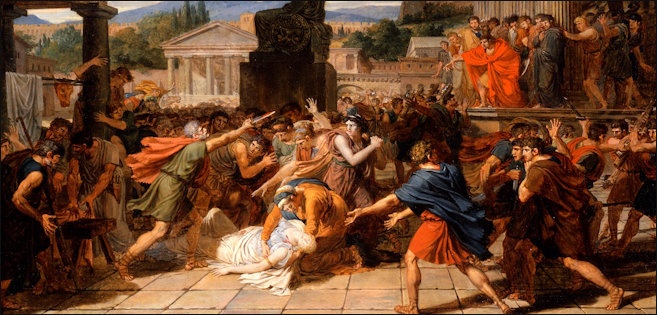
When Gaius travelled away from Rome to personally supervise the commissions work, however, the Senate struck back. They ensured the election of a new Consul called Lucius Opimius, a man with impeccable aristocratic credentials and a streak of bloodthirstiness. Before becoming Consul, Opimius decided to end the Italian citzenship demonstrations once and for all by making an example of an Italian city that had risen in revolt. He oversaw the total destruction of the town of Fregellae, near the modern town of Ceprano in central Italy, and ordered a general massacre of its rioting citizens. Fregellae had been a loyal Roman ally for hundreds of years and her sons had distinguished themselves in the wars against Carthage, and even anti-Italian conservatives balked at the brutal action.

Nonetheless, Opimius became Consul, and did everything he could to dismantle Gaius’ legislation. He declared Gaius a fomenter of rebellion and enemy of the state. Gaius announced in response that he would now run for a manifestly illegal third term, to ensure his important work in service of ‘the people’ could be carried out. In the huge demonstrations that followed, a scuffle broke out between his supporters and Opimius’s, in which one of Opimius’s men was killed. This was all the pretext Opimius needed. He commanded every nobleman in Rome to give him two armed men each. With this army, he marched on Gaius’s home.

Throughout his life, Gauis spoke of having a recurring dream where the ghost of his brother appeared to him, clad in his black robes. Even as his political star rose and he went from success to success, the ghostly figure would tell him, or so he complained, ‘However much you may try to defer your fate, you must die the same death that I did”.

It may have been propaganda concocted to further his political career. Still, that fateful day, as Opimius’s army marched on him, Gaius faced the prospect of this bleak prophecy being realised. Flaccus rushed to defend him, confident that no one would dare lay a hand on a former Consul of the Republic. Opiumius’s men beheaded Flaccus in the street without a second thought, before setting upon Gaius’ followers. Gaius was the only man who escaped the resulting massacre, but he would commit suicide that same day, as Opimius’s men closed in on him. In the days that followed, the Senate ordered the execution of thousands of prominent Gracchan supporters and their families.

IV

Aftermath

The Gracchi brothers were dead, but the populares were far from finished as a powerful political movement, and they hounded the Republic to its last days. Their cause would now be taken up by Rome’s most distinguished general and war hero, a man named Gaius Marius. His career, the story of a soldier of ‘rustic birth, rough and uncouth’ rising to the Consulship of Rome, opposed at each stage by conservative Senators, could be the subject of another blog this size. Suffice to say, with the taboo against consecutive terms now broken, Marius served a positively sacrilegious seven terms as Consul. This gave him the time to enact reforms so far reaching he earned the title ‘the third founder of Rome’. The Senate would have to respond with their own general, a man named Lucius Cornelia Sulla Felix. The fight between Optimates and the Populares, fought in Tiberius’s days by rival mobs on the Capitoline Hill, would now be fought between rival armies as Rome descended into civil war.

Sulla, champion of the Senate, was ultimately triumphant by default as Marius succumbed to old age. Sulla then became the first man to march on Rome with an army and seize power by force. Sulla’s resulting purges of the peoples assemblies were even bloodier than Opimius’s. Every day, proscribed lists of populare supporters would be posted on the Forum, and nine thousand populares were summarily executed as Sulla’s death squads roamed the city. Sulla decreed that the pleb assemblies could no longer pass legislation of their own accord, nor veto legislation from the Senate. When he finally relinquished power, he did so in the knowledge he finally had restored the Senate as the supreme power of Rome.

Sulla’s restoration would in fact not even last a generation. One young boy would escape Sulla’s purges, a teenaged nephew of Marius. Marked for death on Sulla’s proscribed lists, he would spend his youth on the run. With his return to Rome as a young man, he would take up the populare cause begun by the Gracchi brothers, with the familiar battle cries of land redistribution, the grain dole, and an expansion of citizens rights. Sulla was prescient when marking the child for death, for he would certainly go onto become the Senates most formidable enemy.

His name was Julius Caesar, and the rest, of course, is history,

Caesar would cross the Rubicon and crush the Senate. Eager to prevent another Opimius or Sulla ever coming for them again, Caesar’s populare partisans would cheerfully appoint their own champion Caesar Dictator for Life. When a handful of Senators assassinated the Dictator on the Ides of March, they would finally realise how disenchanted people had become with the Republic. Instead of cheering the Senators as liberators, the poor rioted, burned down their estates, and chased them out of Rome. Julius’s successor Augustus Caesar would become the first emperor and would rule on his own for forty years. Though Augustus and his successors were careful to maintain the illusion of republicanism – the official title of the emperors was not ‘Imperator’ (’emperor’) at all but ‘Princeps’, “First Citizen” – Rome would henceforth be a monarchy in all but name. The legacy of the Emperors is complicated – on the one hand, they achieved much of the populare programme. Every citizen of Rome would from the time of Augustus be entitled to a free daily bread ration. They would instute the public work projects and infrastructure for which Rome became famous. The extension of rights continued until the Emperor Caracalla granted every free man in the Roman Empire equal citizenship in 212 AD. On the other hand, the people would never again be able to choose their leaders, vote on their own laws or criticise the government without fear of reprisal. The lost liberty of the Ancestors would become a cherished dream.

The tragedy of the Republic is that it could have been saved, had a few elites prioritised much needed reform over their own selfish interests. Instead, they took the Republic for granted, assured that her centuries old democratic traditions would continue to endure forever, no matter what they did. Even the ‘last defender of the Republic’, the lawyer Cicero, put to death for speaking out against the Dictatorship, had early in his life predicted that the demise of the Republic would come out of the excessive inequality and naked greed that defined its last days:

‘We are silent when we see all the money of all nations have come into the hands of a few men; which we seem to tolerate and to permit with the more equanimity , because none of these robbers conceals what they are doing’
– Cicero
The Tiger and the Liberty Tree: How a rebel sultan tried to make an alliance with revolutionary France to drive the English out of India

PART I

Contact

Toulon, France, 1787. A large French merchant ship, the Roy L’Aurore, registered to one Monsieur Pierre Monneron , makes its way into the busy trading port. The dockworkers, used to seeing flags from all around the world, would nonetheless have frowned to see fluttering from its mast an utterly alien green standard. Arabic calligraphy announces that the ship belongs to the ruler of the Indian kingdom of Mysore, Tipu Sultan, the most hated enemy of the English in India.

The Toulon port officials would have been introduced by the ships captain Pierre Monneron to three bearded, olive skinned passengers in brocaded silk tunics, decked out in heavy necklaces of pearl and jewelled turbans with egret plumes. Accompanying them were was a retinue of fifty stony-faced olive and dark skinned men dressed up in similar fantastical clothes, bright and colourful under the grey French sky.

These, Monneron would have declared, were the royal ambassadors from the sultanate of Mysore – the nobleman Muhammad Dervish Khan, the octogenarian general Akbar Ali Khan and the soft spoken poet Mohammad Osman Khan. They had come bearing fabulous gifts from Tipu Sultan for the king Louis XVI of France – pearls, cotton robes and diamonds. The last gift was all the more precious in those days, when the worlds only known source of diamonds was the Golconda mines of Southern India.

They had also come with a proposal too, from their king. The great Tipu Sultan, Asad-allah-ul-ghalib, the Victorious Lion of God, was engaged in a life and death struggle with the English invader in India. Tipu Sultan knew about the ancient enmity of France and England, and remembered the days of his father the French had offered assistance against the British in India. They had come to persuade the king of France to take up arms again against their ancestral foes, and aid Tipu Sultan in his great crusade.

In return the French would be regarded as eternal friends of Mysore, ‘as long as the sun and moon shall endure’. Her traders would be the only Europeans allowed into the South Indian kingdom, and French possessions in Southern India would be granted Mysore’s protection.

Though, which God forbid , the earth and the skies should be taken from their places, yet shall not our mutual friendship be impaired.

This was the first formal embassy of any kind by an Indian ruler to a capital of Europe. It was an expensive gambit by Tipu. The representatives of the French in India had in truth proved reluctant allies to Tipu’s father, and had dragged their feet about entering Tipu’s war against the English. Tipu solution was therefore to cut out the middleman and approach the French king directly, so that they could deal sovereign to sovereign.

On June 25, 1787, the Indian diplomats would enter Paris on their way to Versailles. Their gifts were displayed prominently in a public exhibition in the city, sparking a fierce debate about France’s overseas adventuring – the kingdom, as it would turn out, was in a financial crisis, a state of affairs not helped by France’s recent intervention in the American revolutionary war. Tipu Sultan’s ambassadors nonetheless caused quite a stir in the Parisian social scene. The  Journal de Paris published almost daily updates on their whereabouts. The exotic politicians were the must have dinner party guests for any fashionable aristocrat living in the city. They lodged in expensive hotels in the Saint Cloud district of Paris, spent lavishly in her restaurants and frequented her operas. They would end up staying almost a year. Mohammed Dervish Khan spent the year obsessively recruiting watchmakers, gunmakers and glass blowers to take back with him to India, while Akbar Ali Khan, despite his age, was rumoured to be carrying on an affair with the daughters of one of the King’s Swiss Guards.

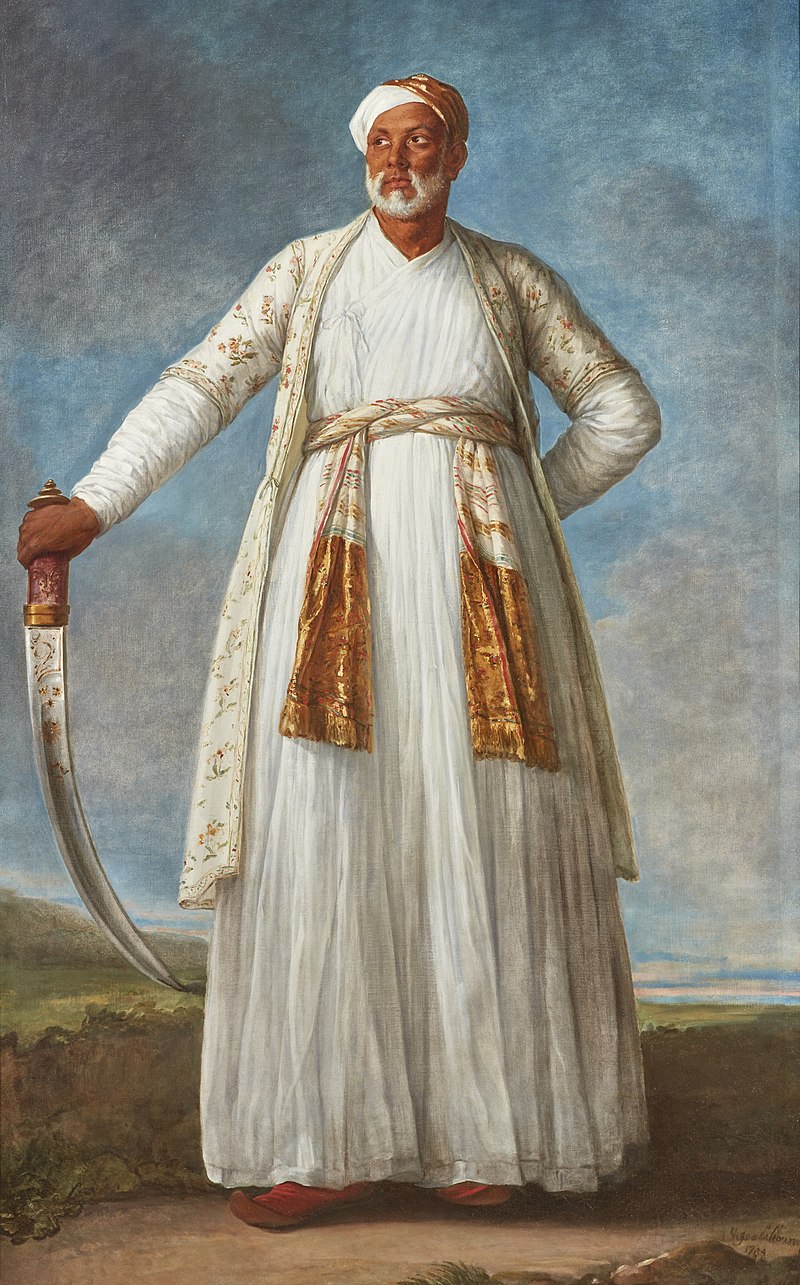
Madame Le Brun, Marie Antoinette’s favourite painter and perhaps the most famous woman painter of the 18th century, had Dervish Khan sit for her at her own request. The rare monumental oil painting that arose out of these sittings, of Dervish Khan in his muslin white fabrics, posing with his hand upon his dagger, was displayed in the Paris Salon of 1789 to critical acclaim.

Madam Le Brun’s famous 1788 portrait of Mohammed Dervish Khan. Madam Le Brun recalled: “I saw these Indians at the opera and they appeared to me so remarkably picturesque that I thought I should like to paint them. But as they communicated to their interpreter that they would never allow themselves to be painted unless the request came from the King, I managed to secure that favour from His Majesty.” Speaking about the haughty pose her subject had `assumed in the painting, she said “He threw himself into such an easy, natural position of his own accord that I did not make him change it.

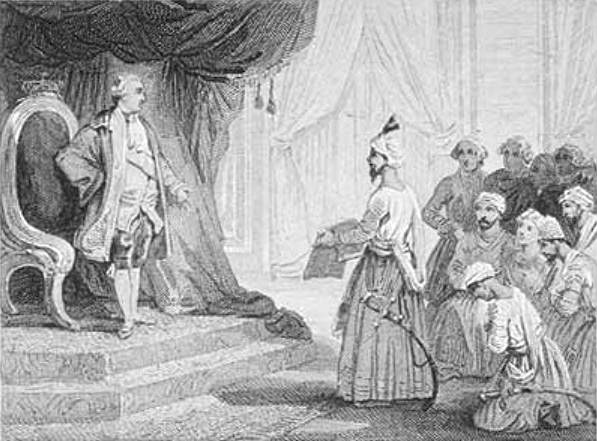
In August 1788 the ambassadors were finally granted an audience with Louis XVI. Though sympathetic, Louis XVI could not help. France was rapidly descending into a crisis of her own making. The moral legitimacy of the most conservative absolute monarchy in Western Europe was being challenged by the new ideas of the enlightenment engulfing the continent. Attempts to modernise the administration and economy to release them from the stranglehold of the nobility had been fiercely resisted by an aristocracy jealous of their ancient privileges. Mere days after the reception of Tipu’s ambassadors, the kings finance minister Brienne would resign, after informing Louis XVI that France was officially bankrupt and unable to meet her interest repayments on the national debt. The price of bread, the staple of the French peasant, had skyrocketed so that it took up 60 to 90 percent of the average labourers monthly wage, and grain riots had paralysed the kingdom. Just as the embassy itself had been a desperate gambit by Tipu, the pomp and pageantry of the royal reception had in fact been nothing more than a last attempt by Louis XVI to show his people he still retained the glamour and majesty of his ancient house.

Louis XVI recieves Mohammed Dervish Khan

The embassy would be frustrated and the nobles would return from Versailles empty handed. The Indian ambassadors fell out of favour back in Mysore and Mohammed Dervish Khan would eventually be beheaded by an irritated Tipu Sultan. The hapless Louis VXIs own journey to the guillotine would also soon be beginning. In July 1789, a Parisian mob would surround and storm the fortress of the Bastille, detonating a powder keg that would change forever the destiny of Europe. The French Revolution had begun.

The effects of what would be one of the first truly global revolutions would open up new opportunities in Tipu’s struggle. But before we get into the story of how the story of revolutionary France intersects with Tipu’s struggle, I shall take a bit of a detour into the history of the man himself – Tipu Sultan, the Tiger of Mysore.

Part II

Tipu Sultan

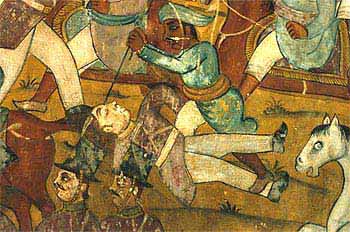
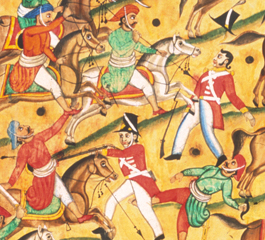
Tipu Sultan had been making a name for himself since 1767, when as a seventeen year old prince under the command of his father Hyder Ali, he had led a daring raid into the British city of Madras, burning down the Georgian mansions of the East India Company officials and almost abducting the Governor. In 1780 Tipu would fully explode into British consciousness when, at the head of one of Hyder’s armies, he completely annihilated the largest East India Company army in South India, in the battle of Pollilur in modern Tamil Nadu. Fifty of the English officers were taken captive, including its commander, the Colonel George Bailie, who has presented to Hyder Ali by Tipu strapped to a gun carriage.

Batttle of Pollilur: Part of a mural commissioned by Tipu Sultan

Over the next few months, as Tipu seemingly won battle after battle, the British would lose control over much of their possessions in South India. Lord Macartney, reflecting on these disasters, remarked ‘the Indians have less terror of our arms, we, less contempt for their opposition. Our future advantages therefore are not to be calculated by our past exploits.’ Such was the scale of Tipu’s victories that by the end of 1780, the historian William Dalrymple estimates that as many as one in five of all the English soldiers in India were being held prisoner by Tipu in his sophistiscated fortress in Seringipatam, in modern day Karnataka in south India.

In Tipu the British had encountered a new kind of native threat – a ruler with a strong desire to create an modern industrial state. Fascinated by modern science ever since he had apocryphally peered through a microscope as a boy, Tipu knew that the feudal ways of old India were gone and understood that power now lay in mastery of this new world of machines and international trade. To this end, he sent not only the first ever Indian embassy to a European capital, described above, but had his diplomats establish Mysorean trading posts as far as Karachi, Oman, Baghdad and Constantinople. His ambassadors to China brought back silkworms that he used to develop a sericulture industry in Mysore, from which the region continues to benefit today. It was on Tipu’s orders that Dervish Khan had spent so much time recruiting watchmakers and glass blowers in Paris. He was determined that Mysore be self-sufficient in the production of gunpowder, and his gunpowder factories were full of modern industrial age innovations. The traveller Jan Lucassen describes Tipu’s gunpowder factory at Ichapur as having a migrant workforce drawn from all over India, workers organisations for collective bargaining , a pension scheme and even a compensation programme for victims of workplace accidents.

The employment of European mercenaries and soldiers by Indian kingdoms was not uncommon in the eighteenth century – in addition to the European trading companies, India was awash in European adventurers and soldiers of fortune. Tipu’s contemporary the Mughal emperor Shah Alam, for example, employed the French sellsword Jean Law as one of his most senior commanders. Tipu’s enemy the Maratha king Daulat Rao Shinde had an entire French batallion under the command of the debonair Savoy general Comte Benoît de Boigne, a royalist refugee. Characters such as the Irish mercenary Michael Finglas, better known by his title Nawab Khoon Khar Jung (literally, ‘Blood-drinking lord of War’) with his private mercenary army of 5000 up for sale to the highest bidder – or Gottlieb Koine, a German Jewish soldier of fortune who started his own dynasty with a Mughal princess, fathering the famous Urdu poet Farasu, were everywhere.

However, for Tipu, recruiting top talent from amongst these lot became an obsession. He used the wealth of Mysore to employ European engineers and European soldiers, mainly French, to reorganise the Mysoerean military among western European lines.

Pollilur

In Pollilur, then, British soldiers used to defeating native armies twenty times their size suddenly encountered well-drilled armies equipped with the latest in military technology. According to the author William Dalrymple, “Tipu’s [sepoys] rifles and cannons were based on the latest French designs, and their artillery had a heavier bore and longer range than anything possessed by the Company’s armies…In many repsects they were even more technologically advanced than the Companies armies,firing rockets from their camel cavalry. The defences of [Tipu’s] fortress at Seringipatnam was designed by French engineers on the latest scientific principles, following Sebastian de Vauban’s research into artillery resistant fortification designs.” Colonel Bailie would recollect his men being subject to the ‘hottest cannonade ever known in India’ in Pollilur, interspersed with missiles from Tipu’s camel rocket cavalry. Finally, accompanied the wailing of the nageshwaram – traditional Tamil oboes – and the beating of kettle drums, his men would be set upon by Tipu’s red coated troops ‘like waves of an angry sea’.

It was the English who would eventually have to sue for peace with Tipu, three years after Pollilur, on humilating terms. Faced with the complete reversal of their fortunes in India, and nearly bankrupted by war, the East India Company propaganda machine went into overdrive. Sensationalistic stories of torture and forced conversions to Islam of the English POWS in Tipu’s dungeons were breathlessly reprinted in the British press. Humiliatingly, it was reported that as an entertrainment for the Indians captured British soldiers were made to wear women’s dresses, ghagra-cholis, and dance before the natives. Tipu was portrayed as an unhinged despot whose implacable ‘hatred of Europeans’ was matched only by his oppression of his own subjects, particularly his Hindu ones. The ‘furious fanatic’ and ‘intolerant bigot’, who had “perpetually on his tongue the projects of jihad’, posed, with his modern European style army, a threat not only to the English but all the kingdoms of India. The whole project to unseat him took on the flavour of that particular species of liberal English imperialism that masquerades as humanitarian intervention. .

The British took up the cause of the Hindu Wodeyar dynasty, the ancestral rulers of Mysore whom Tipu’s father had overthrown in a coup, and encouraged Hindu rebellions throughout Mysore. They began to prise apart the delicate alliance that existed between Tipu and his Hindu neighbours, the Maratha Confederacy, not particularily difficult as the ancient enemies had only recently reconciled. Tipu certainly did have a reputation of being merciless and even cruel to his enemies, and it would not have been hard for the British to point to slaughters of Hindu or Christian rivals as evidence of some religious crusade. The charge that he was a religious bigot, however, was ridiculous. His prime minister Purnaiya was Hindu, as were many of his senior ministers. Despite being a devout Sunni Muslim he was a generous patron of dozens of temples, enjoying particularily close relationshipn with the Srinegeri Math temple, whose head priest he lovingly referred to as jagadguru, the ‘Guru of the world’, the Ragunatha temple, that operated just in front of his palace, and the Nanjudehswara temple,to whom he donated a priceless jade Shiva lingam. Nonetheless, the campaign was so effective that Hindu nationalists even today campaign to have Tipu’s name struck out from the history textbooks as an anti-Hindu bigot.

Over the next ten years, the British would build an impressive alliance against Tipu, which included the two most powerful kingdoms in South India, that of the Marathas and the Shia Nizams of Hyderabad, and a host of smaller kingdoms, who were wary of Tipu’s increasing power. It was in this desperate context that Tipu had sent his failed embassy to Paris. Two further attempts to seek French assistance also ended in failure as France convulsed with the Revolution. Tipu had no choice but to settle down for a fierce resistance which earned him a reputation even amongst his enemies as the ‘Tiger of Mysore’.

And then, all of a sudden, the world turned again. In 1792, in revolutionary France, a radical faction of ultra-egalitarian revolutionaries known as the ‘Jacobins’ seized power from the gentleman liberals and reformist nobles who had dominated the early days of the Revolution. They had a new plan and a new vision for the future. One of the Jacobin government’s first moves was to declare war on England and Holland. Out of nowhere, Tipu’s spies brought him the news that French warships had begun mobilising against the English off the coasts of South India.

A new, odd sort of French soldier would begin to offer their services to Tipu, red capped idealists preaching of liberty and of ‘the great revolution’. In 1794, the first republican revolutionary organisation in India, the Jacobin Club of Mysore, would be founded by this sort in Tipu’s fortress of Seringipatnam.

But who were the Jacobin Club, and how had they come to be involved with Tipu? Before we continue this story, we need to turn back a few years to the events of the French Revolution.

PART III

The French Revolution

‘The words that we have spoken shall never be forgotten on this Earth’

                                                                    – St Just. Jacobin revolutionary

Very soon after Louis XVI was effectively deposed from power in 1789, rifts appeared amongst the revolutionaries about the future of France. The moderate liberal faction did not believe in completely giving up on tradition and abandoning all social heirarchies. Absolute power of the king was out, but instead of doing away with the French monarchical system, it would be reformed as it had in England, replaced by a modern constitutional monarchy where the king remained the ‘father of the nation’ but a legislative assembly exercised all the power. There would be democracy, but in the oligarchic mould of the ‘democracies’ of England and the United States, where only rich land owning men would have the right to vote. The economy would be liberalised, freed from the royal hand and delivered to the the invisible hand of the free market. The church would be reformed but France would remain Catholic.

On the other hand the radical faction coalesced around a social club known as the Jacobin club. ‘Jacobins’ believed in absurd things which appalled the more moderate revolutionaries – voting rights for all men, a secular state, the complete liquidation of the monarchy, the abolishment of all noble land and titles, redistribution of aristocrat wealth and a centralised, controlled economy managed by revolutionary committees. The most radical amongst them even called for extending the ‘rights of man’ to women and to people of colour– ideas anathema not only to most French revolutionaries but to all thinking men of eighteenth century Europe.

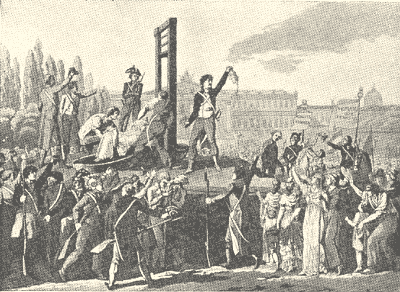
The Jacobins lost no time at all in putting their radical plans in motion once they seized power in 1792. They executed the king and queen and proclaimed the end of the royal line: henceforth France would be a republic. They abolished slavery throughout the French Empire, proclaimed universal suffrage and set in motion a massive programme of wealth redistribution from the lands and wealth they siezed from the aristocracy. However, their ascendancy coincided with a fierce royalist counter-revolution in the Vendee, which the Jacobins believed was being financed by foreign forces. Faced with war and obsessed by the prospect of counter-revolution, an increasingly paranoid Jacobin leadership set about purging France of every last trace of ‘royalism’. They demanded the heads of not only all the old royal officials and artistocrat families, but anyone accused of having of ‘royalist sympathies’, which came to include in time many of their colleagues who for one reason or the other ran afoul of the leadership. In one year, about 17,000 suspected royalists were guillotined in public squares throughout France – a period now infamous as ‘The Great Terror’. The Jacobin thinker St Just sums up the mood of the time

“Soon the enlightened nations will put on trial all those who have hitherto ruled over them.
The Kings shall flee into the deserts, into the company of the wild beasts whom they resemble,
and Nature shall resume her rights’.

After the Terror, it was inevitable that the flame of Jacobinism would be snuffed out. After just over a year in power, they were overthrown by a moderate faction known as ‘The Directory’. The Directory would unleash their own, less well publicised campaign of summary executions against the radicals, outlawing Jacobinism in the new Republic. But as much as the liberal moderates of the Directory touted the possibility of another Terror as justifying the criminalisation of Jacobin thought , it was the radical egalitarianism of Jacobinism that posed a greater threat to the oligarchs of Europe. Already, Haitian freedom fighters calling for independence from the French were reading banned Jacobin books and quoting Jacobin revolutionaries. Jacobinism, with its promise of both emancipation and revolutionary terror, came to occupy the space in the popular imagination that Maoism and Stalinism occupy in Western Society today.

So it cannot have pleased British intelligence, always sensitive to the threat of class war, to learn that Tipu Sultan had allowed his French soldiers to start a Jacobin club at Mysore, aimed at promoting the principles of ‘revolutionary Jacobinism’ in India.

PART IV

TIPU AND THE JACOBINS

With the overthrow of Jacobinism in the mother country, the ranks of the French adventurers and mercenaries in India were suddenly swelled by Jacobin orphans keen to export their lost cause to the wider world. The cause of ‘Le Grand Tippu Sultan’ and his stubborn resistance to the English attained some glamour to these idealists and Tipu was only happy to oblige any assistance from this unlooked for quarter.

Tipu personally oversaw the opening of the Jacobin club of Mysore – an affair that had included a special 2,300 gun salute, the launching of 500 rockets, and the planting of a Liberty Tree. East India Company spies reported that Tipu himself had been inducted into the Jacobin club, had been seen in public wearing the French revolutionary cockade and had been cheered in the Jacobin club as ‘Citizen Tipoo’. The new republics tricolour was hoisted within Tipu’s walls and the Declaration of the Rights of Man proclaimed at Mysore.

‘Death to all the Kings of the World, except Citizen Tipoo’

In 1797 the situation escalated. A rogue Jacobin navy captain named Francis R­ipauld sailed into Mysore and promised the services of himself and his men to Tipu to assist the sultan in his “resistance to the British encroachments in South India”. He spoke of an entire French fleet loyal to the true principles of the Revolution stationed at Mauritius, who would surely be­ persuaded to join Tipu’s cause if he sent them an embassy. Tipu was delighted and gave Ripuald his blessing to act in his name. Ripauld returned to Mauritius along with Tipu’s envoy Abdur Rahim and set about raising an expedition to travel back with him to Mysore.

Ripauld in fact had no authority to speak for the Directory and the admiral in charge of the fleet at Mauritius had no intention of committing the French navy to assisting an outlaw Jacobin and a Mohammedan Sultan. However when he communicated the absurd request to his superiors, orders came from up top for him to assist Ripauld and Tipu in any way he could. The order came not from the Directory but from an up and coming general who was fast becoming a power unto himself in revolutionary France. This general was called Napoleon Bonaparte, and he was very, very interested in what Tipu had to say.

Cometh the hour, Cometh the man – Napoleon in Egypt

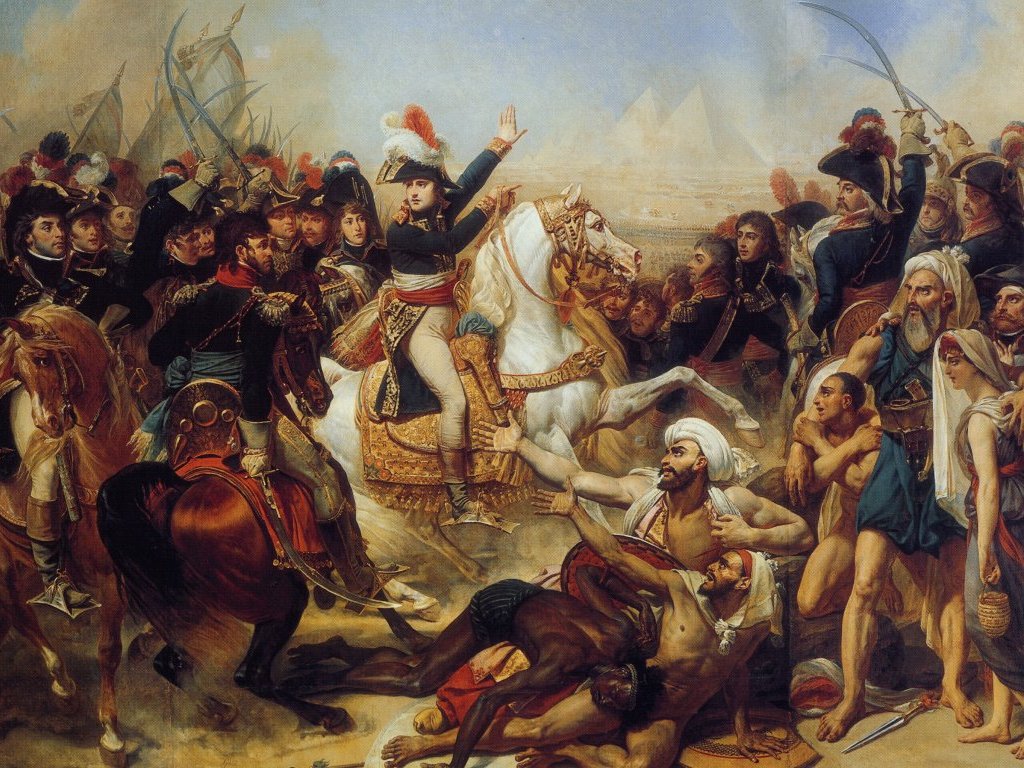
Napoleon had long dreamed of restoring French interests overseas, and perceived the formidable threat England would pose should the riches of India fall into her lap. Years before he had proposed to the Directory a fantastical campaign in the far east, where he would capture Egypt and Syria. This would allow him to control all the sea routes to the Orient. He would then lead an army into southern India to fight the English there. He disdained the East India Company as as society of ineffectual merchants, and assured his superiors that the ‘touch of a good French sword’ was all that was needed to collapse ‘the mercantile empire’ of the English. The Directory had been uninterested, but after Napoleon won a series of spectacular victories in Italy, they began to fear his influence and were all too happy to have him as far away from Paris as possible.

Napoleon’s army conquered both Egypt and Syria easily. No sooner had he subdued Egypt did news reach Napoleon in Alexandria of Ripauld and Abdur Rahim  in Mauritius, asking for French assistance to drive the British out of South India.

In 1798, Napoleon would write personally to Tipu Sultan,

“To the most magnificent Sultan, our greatest friend Tipoo Sahib,

You have already been informed of my arrival on the borders of the Red Sea, with an innumerable and invincible Army, full of the desire of delivering you from the iron yoke of England..I would ask that you send some person to Suez or Cairo, bearing your confidences, in whom I may confer. May the Almighty increase your power and destroy your enemies

Yours C & C,

Napoleon Bonaparte

Frances Ripauld would suddenly be granted the expedition. In 1798 he and Abdur Rahim sailed back into Mysore at the head of an army of French volunteers. They were hailed as heroes and given a robe of honour by Tipu Sultan.

Napoleon’s letter, the culmination of all Tipu’s efforts for French intervention, would ultimately be the thing that sealed Tipu’s fate. English intelligence intercepted the letter. The Tory Governor General of India, Lord Wellesley, had long been fighting with the board of the East India Company to commit more resources to eliminating the threat of Tipu Sultan. Now he wrote to his superiors that the battle against Tipu had attained the character of a national emergency, with implications in the war against France. This was enough for the directors of the Company to persuade their friends in Parliament to shake the magic money tree. Lord Wellesley was granted all the resources he needed. An army of 50,000 men under the command of his younger brother, Arthur Wellesley, the future Duke of Wellington, was sent out to Seringaptnam to end once and for all the threat of Tipu. Their Maratha and Hyderabadi allies joined him, and in 1799 a great siege of Tipu’s fortress would begin by these three armies.

Meanwhile Napoleon would suffer the first major catastrophe of his career in Egypt. An English fleet under the command of the swashbuckling Horatio Nelson would surprise Napoleon’s ships in Acre in modern day Israel and utterly decimate his fleet. Napoleon would be recalled to France the next year. He would never again return to the Far East.

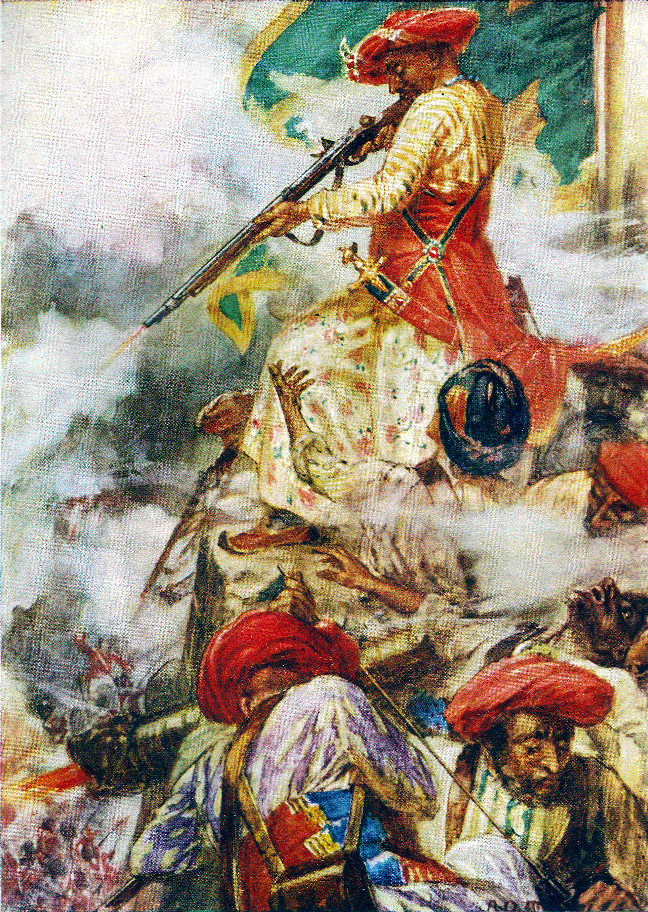
Tipu Sultan at the siege of Seringapatam

Friendless, Tipu would hold out for a nine month long last stand in the siege of his capital Seringapatam. The Jacobin volunteers fought with him to the end. At one point in the siege of Seringapatam observers would have witnessed the odd sight of Tipu’s French revolutionaries fighting the Marathas’ royalist French mercenaries, one French army flying the fleur de lys banner of Louis XVI, the other bearing the revolutionary tricolour, both clashing under an Indian sky amongst jostling Indian armies

By the end of the year, the English armies breached Tipu’s walls. Seirngapatnam was burnt to the ground, and Tipu sultan’s body was found hacked to death amongst the fortresses defenders. Amongst the effects stripped from the modernising sultan’s person would have been his favourite Swiss pocket watch, without which he was never seen in public.

The battle marked a major turning point for the British in India. It also sparked the realisation amongst Wellesley and his lot that as long as there remained any powerful independent kingdoms in India, they could not be trusted not to deal with the enemies of the English. The English had already noticed how the Marathas had been slow to send their army, how they had been watching carefully to see how the alliance with the French would work out for Tipu. The next fifty years would see fierce battles waged on the flimsiest of pretexts by the English against all the great powers of India, beginning with the Marathas. Arthur Wellesley’s meteoric rise to the prime ministership of Great Britain would begin the day Serangipatnam fell – he would of course go onto defeat Napoleon as well, in Waterloo, fifteen years later.

The episode stands as a testament both to uniquely global nature of the French revolution and to global vision of Tipu Sultan. Had Tipu succeeded in his plan, it would have changed the history of the British empire, which may never even have come into being without India. By extension it would have changed our modern world, born out of the British Empire’s collapse.

For a brief moment, then, Tipu and the French revolutionaries had stood on the precipice of an entirely new world.

Chaos under Heaven : The Forgotten and Sorry tale of the first failed British attempt at the conquest of India

The traditional narrative of the British colonisation of India begins with Battle of Plassey in 1757, where the private mercenary armies of the English East India Company defeated the powerful Nawab of Bengal, Siraj-ud-Daula. For the Companies armies, led by the infamous Robert Clive, the prize of this stunning victory would be the governorship of the immensely wealthy old Mughal province of Bengal. From Bengal, British rule would gradually spread over India, so that they would become unchallenged masters of the continent from the 18th till the very middle of the 20th century.

However, what is less well known that is the rather more ignoble story of the first English attempt at conquest in India, almost seventy years earlier in the year 1690. This is referred to as the ‘Moghul war’ or sometimes the first Anglo Indian war. Unlike Plassey, this resulted in a humiliating and total defeat for the English – so much so that the English would for an entire generation pursue a policy not to engage in land wars on the continent. Indeed, even in 1757 when Clive would annex Bengal and sow the seeds of the British Raj in his infamous ‘200 days’, he would do so against the wishes of his bosses in London.

That the failed escapade of the 1690 Anglo Indian war was usually omitted from Imperial accounts of the history of British India is of course not surprising – the glorious victory at Plassey where a handful of hardy honest English men under Clive defeated a native army which outnumbered them twenty five to one is a much more romantic beginning for the story of the Raj. What is more surprising is that the 1690 victory over the Western Invader scarcely finds mention in Indian nationalist accounts of imperialism, which otherwise are adept in turning even defeats into ‘moral victories’.

The reason for this is the victor of the 1690 war was the Mughal Emperor Aurangzeb, a pious orthodox Muslim. In India he remains a character of some controversy owing to his break from the tolerant traditions of his more libertine Mughal ancestors when it came to the other religions of India. Posterity has not been kind to him – his zealotry did little to endear him to the more secular minded older generation of post-colonial Indian nationalists , while modern religious Hindu nationalists regard him as practically a demon, the very apex of the Muslim ‘subjugation’ of India.

In today’s right-wing Hindu India where actively forgetting the Islamic roots of our contemporary culture has become a patriotic project, or in today’s bravely post-imperial Britain where people are ‘very sorry’ about the history of colonialism but not very interested, this is unlikely to change. Which is a shame, because it is fascinating story – a tale of incompetence and arrogance to the greater glory of no party and a fascinating look at both the early workings of the East India Company in the days before her empire and at the Mughal empire at the height of her power.

The architect of the first Anglo-Indian war was one Sir John Child, the governor of Bombay and a man in temperament not unlike Clive. Like Clive, so convinced was he about the innate superiority of the Englishman to the pusillanimity and cowardice of the native, that he sought to conquer an Indian kingdom for himself with a tiny mercenary army. However, unlike Clive who was able to take advantage of the power vacuum left by a crumbling and dilapidated Mughal empire , Child would have to face a united Mughal Empire at the very zenith of its power, and in Aurangzeb, a ruthless and powerful adversary.

Part I

Humble Beginnings

The East India Company had humble beginnings in India, for the English were relative latecomers to the game of colonialism. The great colonial powers of the sixteenth and seventeenth centuries were the Spanish, the Portuguese and the Dutch. Indeed, the East India Company itself, which would become ‘the Greatest Company of Merchants in the Universe’ would start out as a very private venture by a handful of private individuals with little support from the Crown.

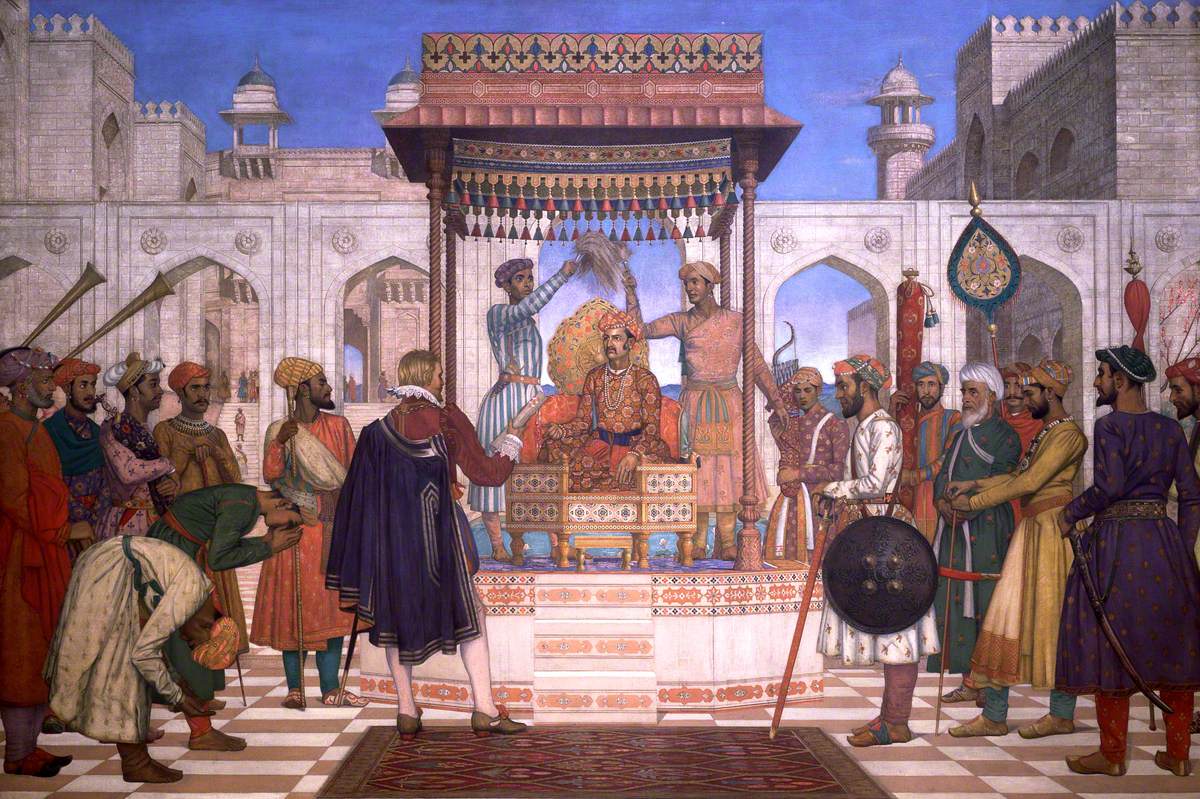
The first formal English ambassador to the Mughal Court was one Sir Thomas Roe. In 1615 Roe landed in India, an aristocratic explorer of the eccentric Elizabethan type. He was a figure of some glamour in England, having charted the then unmapped Amazon and having led three separate expeditions to try and find the legendary city of El Dorado. He now came to India bearing papers announving his embassy on behalf of his king James I to the King of Kings of India, the Emperor Jahangir.

 
Rothenstein, William; Sir Thomas Roe at the Court of Ajmir, 1614; Parliamentary Art Collection; http://www.artuk.org/artworks/sir-thomas-roe-at-the-court-of-ajmir-1614-214159

This painting above commemorating Roe in India hangs in the British Parliament. To see it is still to be struck with a strong sense of how difference the power dynamic was in the early days between the English and the Mughal Empire. In Jahangir’s time, the empire was it’s peak and India was in the midst of its last great golden age. Under Jahangir’s father, Akbar the Great, the Mughals had succeeded in uniting much of the northern subcontinent under one ruler for the first time in two millennia. Jahangir was absolute autocrat over 100 million people, almost twenty percent of what was then the worlds population . More people lived in his dominions, he could boast, than in the mighty Ottoman empire, than in all the petty kingdoms of Europe put together. As far as Jahangir was concerned, he was Lord of the whole world – fitting for one who had taken the title Jahangir on his ascension to the throne – ‘World Seizer.’


Roe would soon experience the reality of Jahangir’s indifference to his embassy. He would spend months trying to get an audience with the Emperor, fretting and fuming at the edges of the Court. During this time he and his men were routinely harassed by the Governor of Surat, a man with business links with the Portuguese, England’s rivals. Only after Roe’s fixer in India – a local man who according to Roe called himself ‘Jaadu’, or ‘Magic’- managed to open a line of correspondence between Roe and the Empress Noor Jahan Begum, by many contemporary accounts the true power behind the throne, would this audience come about.


After another four years in India, Roe specifically counselled against the English establishing permanent settlements and a standing army in India ‘Without controversy’ he wrote ‘It is an error to affect garrisons and land wars in India’. He had before him the example of the tottering Portuguese empire, who had indeed maintained forts and conquered provinces in India and had inevitably become drawn into Indian politics, to the ruin of her great empire. The Portuguese’s ‘many rich residencies and territories’, Roe observed ‘have been the beggaring of her trade’.
‘Let this be a rule’, was his advice to the English King’ that if you will to profit [in India], seek at it at sea and in quiet trade’
Thomas Roe, an aristocrat through and through, bore all of the nobility’s disdain for the low-born ‘men of trade’ who made up the then fledgling Company, and had taken a gloomy view of their prospects in India. He blamed the tradesmen in part for his initial failures with Jahangir, saying that the Mughal court had been so awash in money grubbing European adventurers claiming to be the representatives of some or the other European king that the Mughals had been unable to recognise him as a ‘Man of Quality.’ Roe would eventually claim friendship with both Jahangir and the crown prince Khurram (the future Shah Jahan) after finally having had his Quality recognised. It is telling though that Jahangir himself was a keen diarist, and yet his exhaustive memoirs do not mention this friendship at all.

On his own account, when Roe was not enjoying the notoriously hedonistic Jahangir’s wine parties, Roe seems to have spent much of his time undermining the  East India Company’s men, criticising many publicly and openly decrying the ‘error of factories’ .


Though later British Imperialists would credit Roe with securing the first ‘trading rights’ for the Company in Surat, keen to establish a long-standing basis for existence of the Company in India, Mughal administrative records show no formal imperial decree, or farman, confirming any permanent grant of land the Company. In any event, the World Seizer did not enter into anything so plebeian as ‘contracts’ – he issued farmans as the Shadow of God on Earth, and any such grant only existed so long as he willed it.

Much to the annoyance of the ambitious East India Company men eager to secure royal backing for their ventures , Roe’s attitude of indifference towards India in general – a ‘dreary place’- and the abilities of the rough, freewheeling Company men in particular remained the dominant view of the English Establishment for the next 80 years. Indeed, matters would get even worse. In the 1640’s and 1650’s, England herself would descend into the Anarchy unleashed by the Civil War between King and Parliament, an anarchy that would only end with the beheading of a King and the estabishment of a short lived Republic, which would proceed to abolish the very Crown that Roe had once represented and from which the Company drew its patronage.
Cut off from their motherland in every possible way, for a time the Company Men in India must have felt truly alone.

Part II

The machinations of Sir John Child, Baronet.

However, by the end of the century, matters would begin to look up from the Company’s point of view. The Monarchy had been restored, and the new king Charles II was a reformer, no doubt by circumstance. Charles’s accommodation with Parliament had meant ceding many of the ancient rights of Kings to Parliament , and as such he was a man much more in touch with the modern world of trade and international commerce.

Doubtless conscious of the Company’s many wealthy backers amongst Parliament, Charles II enthusiastically gave his support to company ventures, even leasing the company a small coastal settlement of it’s own on the Indian mainland. Charles II had received the settlement – formerly a Portuguese territory – as a wedding gift from his Portuguese bride. It had turned out however to be an unwelcome expense to maintain- being nothing more than a palm tree laden Portuguese governors mansion and a thin strip of beach on the West Coast of India. The Portuguese had called this tiny unimportant governor’s villa Bon Bahia ‘The Good Bay’ . The English would very soon garble this into ‘Bombay’.

Then, in 1682, a company agent (or a ‘factor’) Sir John Child, who had been in India for three decades in the service of the Company – a man with a wide network of ‘cronies’ and ‘relations’ in India- was promoted to the Presidency of Surat and became governor of Bombay. His appointment was a clear sign that the the time when the Company would determine British policy in India was at hand.

The beginnings of Child’s governorship of Bombay would be inauspicious to say the least. The Board of Directors and shareholders of the Company had long been grumbling about the costs and demands of the ever expanding new settlement. By the 1670s, only thirty years since being leased to the the Company, Bombay had been settled by 300 English, 400 ‘Topazes’ (Indo-Portugese), a militia of about 500 ‘natives’ and about 300 ‘Bhandarees’ – club-weilding toddy tappers who worked the palm trees. Child, a devoted company man and a huge believer in the Company line, would set about a ruthless cost cutting project, slashing Company funding for infrastructure and public works in Bombay. At the same time, he managed to amass a personal fortune of £100,000 and net himself a baronetcy for his service to the Company. Unsurprisingly, these measures were decidedly unpopular with this early generation of ‘Bombay-wallahs’ .

In 1683, one year into Child’s governorship, when Child proposed cuts to the salaries of the English soldiers stationed in Bombay, it was a step too far. Richard Kegwin, a decorated Royalist veteran, raised the standard of revolt on behalf of the free citizens of Bombay, citing John Child’s ‘intolerable exertions, oppressions and unjust impositions’ and accusing him of not ‘maintaining the honour due to His Majesty’.  Child was chased out and a Free State of Bombay declared – one of the few instances of an English led rebellion in India against East india Company rule. For the next two years of his Governship, Child would be exiled from his own city, cooling his heels in Surat.

Kegwin ruled this free state of Bombay for these two years and by all accounts his governorship was fair and even-handed, extending to pursuing friendly relationships with the neighbouring Indian kingdoms with a policy of peaceful co-existence and trade. However Charles II had no appetite to step on the Company’s toes, and sent the Navy to relieve Kegwin of his ‘command’ and to return to England. The ‘naughty rascal’ Kegwin finally dealt with, Child could skulk back to Bombay to enact his petty vengeances on anybody who supported Kegwin’s rebellion.

If Child was humbled by this early referendum on his capacities as an administrator, he certainly did not show it. Rejecting decisively Kegwin’s policies of mutual co-existence and casting his eye about the political landscape of India in the closing years of the seventeenth century, he instead saw opportunities for conquest and for the ‘Bombay Presidency’ to become something greater than a solitary outpost at the peripheries of civilized India.

Part III

The machinations of Emperor Aurangzeb

Some eighty years after the death of Jahangir, cracks were finally beginning to show in the once impenetrable Mughal edifice. Jahangir’s grandson Aurangzeb, a deeply orthodox and conservative Muslim, had turned his back on the tolerant traditions of his father and grandfather and had taken the hugely controversial step of imposing jizya, a tax on non-Muslims, throughout his empire. Though jizya was commonplace in most Muslim kingdoms, including the Delhi Sultanate that had preceded the Mughals, it had been abolished by the Emperor Akbar who decreed that none of his subjects would be interfered with on account of their religion. The taint of illegitimacy also hung over Aurangzeb’s kingship, for he had succeeded the throne by imprisoning his father and murdering his elder brother Dara Shukoh, their father’s chosen successor. 1

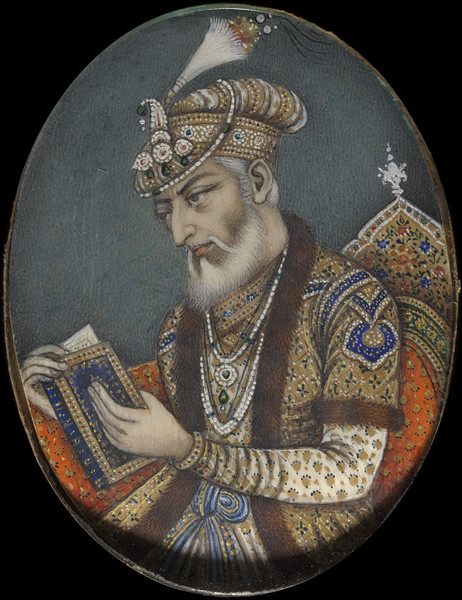
The Emperor Aurangzeb

Unsurprisingly, Aurangzeb’s reign saw unprecedented religious unrest and Hindu and Sikh revolts throughout his empire, the beginning of the slow but ultimately irreversible unravelling of the Mughal state. Perhaps the most spectacular of these was the rise of the Marathas, Hindu warrior clans from the Deccan hills, who till that time had seemingly been content to be either soldiers for hire in the service of other Indian powers, or free raiders, but out of nowhere had been united by a charismatic and intelligent leader with territorial ambitions of his own, Shivaji of the Bhosle clan.

Shivaji and his followers would proceed to inflict a serious of increasingly audacious defeats on the Mughal empire. The English would experience this first hand when in 1664 the famous Maratha cavalry swept into Surat, the capital of Mughal Gujarat, and plundered the city for forty days without resistance. The English’s main factory in India at the time was in Surat and it would have been looted and burned along with rest of it had not the English factory workers barricaded themselves inside the factory and mounted a surprisingly resolute defence of it from its walls for those forty days. The English were not at this stage allowed to maintain their own army under the terms of farman allowing them to trade in Gujarat and had relied exclusively on the Mughal army for protection, but their ‘protectors’ had instead had been totally outmanoeuvred by the Marathas and cut to pieces. Though the English were pacified by gifts and an exemption of custom tax by the grateful Aurangzeb for their role in the defence of Surat, Shivaji would do an encore performance on the hapless citizens of Surat in six years time and the Board of Directors of the Company would begin to seriously re-evaluate the merits of their continued arrangements with the Mughals.

Mughal control over the sea trading routes was also no longer absolute, for Shivaji, as part of his programme for a modernised Maratha ‘state’ had created the first Maratha navy, and by the 1680s Maratha and Mughal ships were openly clashing near the Bombay harbour itself.Child, referring to these events, was able to persuade the board of the Company, then chaired by a man with whom he coincidentally shared a surname, Sir Josiah Child, that time had come to move away from the long propounded axioms of Sir Thomas Roe not to ‘affect land wars’ in India and adopt instead a stance similar to the long-established practice of the Dutch and the Portuguese in India. That is, they needed permanent residencies fortified by their own armies in which they were ‘soveriegn’ ,so that they were not so dependent on the whims and fancies of ‘petty princes and potentates’

Part IV

Chaos under Heaven

Child’s moment came when a conflict arose between East India Company merchants and the Mughal governor of Bengal over customs duties , which saw a faction of the English agents in Bengal taking arms against the Mughal governor Shaista Khan. Rather than intervening to smooth over the conflict, Child lent his covert support to the rebelling Bengal merchants, encouraging them to secure by force of arms a new permanent settlement in Bengal. The Board, led by his John Child’s benefactor Josiah Child, was persuaded to send a a fleet of warships to aid in this effort – the beginning of Child’s vision of a sovereign English presence in India. Meanwhile Child set about fortifying Bombay.

Somehow Child had expected that all of this would go unnoticed and that the Mughal governor of Surat would keep on allowing them to trade in Bombay as before. In the word’s of one of Child’s critics ‘By what rule of policy could ..Sir John Child think to rob, murder, and destroy the Moguls subjects in one part of his dominions and the Company seek to enforce a free trade in other parts? Or how could he expect that the Mogul would stand neutral?’

Perhaps Child shared the view of Josiah Child, that the Mughals had become so dependent on English trade that they would have to seek terms with the English whatever the cost and be compelled to overlook these power grabs. In any event, this was not to be.

Aurangzeb retaliated by confiscating East India Company shipping vessels at sea and immediately imprisoning all the East India Company agents in Surat, parading them through the streets in chains. Aurangzeb did not have to suffer a loss of European trade either – the East India Company’s trading rights were simply transferred to another European businessman named ‘Messr Boucher’ – a former rival of Child from the days of Kegwin, who had been imprisoned by Child but somehow escaped and sought asylum with Aurangzeb. He had set up a rival company to the East India Company and the Mughals set him up in the recently vacated East India Company warehouses. It made no difference to Aurangzeb, after all, what specific group of Europeans he traded with.

The ‘Bombay Presidency’ of the East India Company was almost brought to ruin by these events. The desperate Child was able to negotiate the release of the East India Company factors in Surat, paying hefty fines to the Mughal governor. When he returned to Bombay however he found out that the Mughals had imprisoned all the Company men in Surat again, almost the moment his back was turned.Child, incensed, ordered retaliatory attacks on Mughal shipping. Warned that his actions would surely attract the attentions of the Mughal Navy, then led by celebrated admiral Yakub Siddiqui, Child replied with his characteristic bravado that he would be able to repel Siddiqui by the force of ‘the air from his bum’.

It was not to be. In 1689, the Mughal Navy, under the command of Yakub Siddiqui himself, landed 20,000 men on the beaches of Bombay. The English were completely taken by surprise. Not a shot was fired from the English side, except the warning gun. The forts of Mazagaon and Mahim were occupied by the Mughals in days and Siddiqui advanced on Bombay castle. Siddiqui then set about erecting artillery batteries, which, according to one of those who later escaped the siege of Bombay ‘bombarded our fort with massy stones’. The English mounted some forays against Siddiqui, but Siddiqui saw them off with ease. The garrison meanwhile was beset by desertions.

As the Mughals occupied Bombay, the hapless English residents had to seek refuge in Bombay castle. In an attempt to starve them out, the Mughals burned the entire city to the ground and the English were trapped in the castle from April to September of 1689, with ever dwindling provisions and sickness soon ravaging their numbers. One Englishman had a brilliant idea to somehow get out a message to appeal for assistance from the Mughals rivals, the Marathas. Though 3000 Maratha cavalrymen did ride to their aid and stave off the Mughal advance for some time, feeding and paying the Marathas for their services further impoverished the hapless English.

Bombay was in the meantime absolutely destroyed by the Mughal army. From a population of about 800 English citizens, there were eventually no more than 60 left alive.

There was nothing else to it. The English had to make peace. The English had to send of their most two senior agents in India to present themselves to Emperor Aurangzeb to try and negotiate a truce. They were immediately imprisoned. With their hands bound in chains, the Englishmen had to perform the abject ritual prostration before Aurangzeb in open court in front of the entirety of the gathered Mughal and Rajput nobility. They were made to go down on their knees and bend before him so that their foreheads touched the ground, begging Aurangzeb’s forgiveness as his ‘errant children’ and as his ‘slaves’.

‘A new mode for ambassadors’ sneered one critic of John Child. Aurangzeb in turn delivered a severe reprimand to the Englishmen, rebuking them in condescending terms. This was not an exchange between two sovereign powers – by doing this the English were pointedly acknowledging the overlordship of Aurangzeb over the English, in accordance with the rituals of Mughal courtly etiquette. It is the exact same ceremony with which a defeated Indian king or rebel would be brought before Aurangzeb and either accept his vassalage or die.

After making them confess their faults and beg his pardon, Aurangzeb relented to restoring the English’s trading rights, but only if they accepted a series of onerous conditions. They had to pay for the repair of all the Mughal ships they had destroyed and compensate the Mughal treasury for all the goods they had plundered. On top of that, the East India Company would have to pay him an indemnity of a 150,000 rupees. Henceforth, Aurangzeb decreed, the activities of the Company ‘must proceed in accordance with my will and according to my pleasure’. Under no circumstances would the English ever be allowed to maintain a standing army in India or militarise as they had tried to do under Child. It went without saying that some Englishmen would have to remain at his court as a guarantee of good behaviour. To quote the historian John Keay, these were the most humiliating conditions the English would ever have to swallow in India.

Aurangzeb was not done. He had one further condition. The English must hand over the detested John Child, to face Aurangzeb’s justice. The English had no choice and duly accepted, imprisoning Child and putting him on a transport to Delhi.

What Aurangzeb would have done to Child was anyone’s guess. While being transported to Aurangzeb’s custody, Child died in mysterious circumstances. ‘A shrewd career move’ one observer remarked acidly.

The story is remarkable because it challenges to the core the traditional imperialist narrative, with glamorous tales of European exploratory prowess and moral and technological dominance over the native. It would by necessity be forgotten in British India because it so undermined the entire basis of the Empire – the inherent superiority of the European to the Native.

However the fact that what may be the most humiliating defeat the English ever suffered at the hands of an Indian king continues to be forgotten in today’s India says as much as about contemporary India. It is as inconceivable to the Hindu nationalist right that the English’s first defeat would come at the hands of the hated Aurzangzeb, as it perhaps was to the Empire that they could be so soundly defeated by a native prince.

In fairness to Child he was perhaps prophetic when he saw the seeds of the Mughal empire’s demise in the policies of Aurangzeb, but the English fatally overplayed their hand by striking out so early. The Mughal empire, though racked by war – Aurangzeb would become an old man in the saddle – remained one of the most powerful empires in the world. In those days, before the industrial revolution and the invention of the Gatling gun and the coming of the railroad, the European enjoyed no inherent technological superiority to the great ‘gunpowder empires’ of Asia like the Mughals, the Ottomans or the Chinese. It would take a few more generations of misrule and a series of catastrophic invasions from Central Asia that would cause the Mughal empire to weaken to the point that Clive could finally conquer Bengal at Plassey.
‘After me, chaos’ Aurangzeb was reported to have said on his deathbed. And so it was.

The King who never went to Friday prayer – a history of the Sultan of Delhi Alauddin Khalji (with a brief foray into contemporary politics)

Every so often India’s secular credentials are tested and are found wanting. The latest case in point -the Bollywood movie Padmavat. Padmavat is ostensibly based on a medieval Rajput legend, about a heroic Hindu prince of Chitor, Maharana Ratan Singh, and his Queen Padmavat. Padmavat’s beauty attracts the unwelcome attentions of the devious and ravening Muslim Sultan of Delhi, Alauddin Khalji. His advances are rebuffed by the modest Hindu maiden, his demands that the Hindu upstart prince hand over the girl met with the laughing of proud Rajput braves. Frustrated, Alauddin Khalji sacks the fort of Chitor with his vast horde, and kills the heroic prince so that he may all the better claim Mewar’s most precious jewel, the Queen Padmavat. Rather than face dishonour at the hands of the Muslim conqueror, she commits the horrific rite of jauhar, ritual suicide by self-immolation. Death before dishonour – emblematic of that fierce Rajput martial pride which would enchant Orientalist Europeans for centuries.

Of course, it didn’t happen. Though Khalji and the Rana existed, there are no contemporary accounts of any queen of Mewar named Padmavat. She is first mentioned hundreds of years after her supposed death in the 13th century in the poem of a 16th Muslim Sufi poet, Malik Muhammad Jayasi, and is widely accepted by historians to be his creation. In time honoured Indian fashion, Ustad Malik Muhammad simply spiced up his epic poem about the sack of Chitor, ancient history even in his day, with a love story.

None of which prevented Padmavat from becoming one of the most controversial movies in Indian cinema. Even while filming , word spread around about a movie depicting the dishonour of a proud Hindu princess at the hand of an invading Muslim King. Some even whispered that the movie showed the relationship to be consensual.

The Hindu right predictably took the bait, cast as it was by the films liberal elite Bollywood director Sanjay Leela Bhansali into that great seething river of cultural anxiety that is Modi’s right wing Hindu India, where the Muslim Invader looms large as the architect of an an ancient ‘subjugation’ which predates even the conquest of the British.

Protests broke out all over the country about the movie. The film sets were regularly vandalised and even set fire to. A Rajput caste organisation, the Rajput Karni Sena, attacked the director on set, whilst the cast members got death threats. . And none more so than the actress Deepika Padukone, who dared to plays the mythical Padmavat as a wanton harlot. No sooner did one high ranking politician of the ruling Hindu right wing BJP party announced a cash bounty for her murder did another double it, saying her nose should be struck off, like the Hindu God Ram did to the demoness Suparnakha in the ancient Hindu epic the Ramayana.

And so a fictional Hindu queen invented by a Muslim Poet found herself reborn as desh-maata – the mother of India. The irony of seeking to protect the ‘honour’ of a fictional queen by sending death threats to an actual young woman was one of the many contradictions those defenders of the desh maata were willing to accept.

The move was banned in several parts of India, criticised by the ruling party and attempts were made even to ban it in the UK. When the Supreme Court of India overturned the ban it was hailed as a victory for free speech.

So what a turn of events it was, that when the movie was released its politics turned out to be every bit as reactionary as the people protesting it. Aluaddin Khalji is not portrayed the urban sophisticate from Delhi that he actually as was but as a barbaric raider and savage, an outsider from Afghanistan rather than someone who had been born and spent all his life in the country now called India . The Hindu princes are almost cartoonishly upright and honourable, delivering endless sermons on Rajput valour. The Hindu right, pacified, backtracked on their criticism and nationalist journalists called it a great tribute to Rajput honour.

Much of the liberal criticism of the movie has rightly focussed on the regressive and patriarchal portrayal of its titular heroine. I would like to however write about the subject of the movies intensely political character assassination – someone who I believe is one of the most fascinating kings in Indian history – Sultan Alauddin Khalji.

Alauddin Khalji

Like any successful ruler in medieval India, Hindu or Muslim, or indeed in any medieval society, Khalji was a ruthless and ambitious man, and indeed came to power with the murder of his uncle, in a bloody familial struggle which was nonetheless typical of the time. However what is interesting about him is what he did with the power.

At the outset it is important to note that Aluaddin Khalji’s reputation as a bloodthirsty king comes not from the contemporary writings of Hindu kings of his time but from the writings of the orthodox Muslim clerics or ulema of his court.

The ultra orthodox views of Barani, who lived through Alauddin’s reign and chronicled his life, was typical of the literate elite of the time. He writes of Alauddin that he ‘shed more innocent blood’ than ‘the Pharaoh ever did’. However from reading him it becomes clear that his chief complaint is Alauddin’s increasing encroachment into realms previously thought to be the prerogative of the ulema. The ulema wielded great power in the Delhi Sultanate, and for all the worldly power of the sultan it was they who gave his laws Divine Sanction, in addition to dominating the sultanates judiciary and administration.

The problem with Alauddin was that he was not particularly religious and greatly resented the power of the clerics, whose power he constrained at every turn, removing them from positions in the administration and replacing them with his men. In the shocked words of Barani, ‘the sultan holds that matters of administration have nothing to do with religious laws.’ Elsewhere Barani censures Alauddin saying ‘the sultan said no prayers and did not attend Friday prayer in the mosque..he was not at all careful at all about prayer and religious fasting.’

Indeed, if Barani is to be believed, then Alauddin Khalji is probably the first sultan to have come up with the idea of beginning an entirely new religion, centuries before Akbar came up with the idea.. Barani reports Alauddin as actively threatening the clerics and Islam itself, boasting that ‘If I am inclined I can establish a new religion and creed ; and by my sword and the swords of my friends force all men to adopt it.’

When Barani finally compiled his chronicle of the life of Alauddin Khalji, wisely waiting until the subject of his history was many years in the grave, nowhere amongst his list of ‘the ten achievements of Alauddin Khaliji’ is ‘converting the infidel’ or ‘destroying the worshipping places of pagans’ as would be expected in the history of the time of a good Muslim King . ‘Repairing mosques and minars’ (along with water-tanks) is the closest Alauddin gets, but this is a distant eighth on Barani’s list. According to Barani, first amongst the Sultan’s achievements was the ‘cheapness of the necessities of life’. The economic nature of the Sultan’s achievements are a theme in this list – down the list are ‘honest dealings of the bazaar people’ , ‘safety of the roads’ and ‘flourishing of many learned men even without the patronage of the sultan’.

Though these bureaucratic achievements would have seemed less noble to readers of the time than being a holy warrior or a devout man of a God, to our modern eyes these are truer marks of a good ruler. When the great Moroccan traveller Ibn Batutta compiled the accounts of his travel to India many years later in Tangiers, where neither fear nor favour could have affected him, he also attests to Alauddin’s popularity, saying he is regarded as the ‘best of sultans, and the people of India eulogise him highly’. Similar eulogies can be found in the gushing praise of the Persian poet Amir Khusrau who said that law and order were so relentlessly enforced in Delhi during his reign that ‘none dared to even pick up a fallen jewel in the street’. But it is the fact that Barani, who elsewhere depicts the king as a godless violent fiend, has to begrudgingly concede these achievements is what I think is most telling about the man himself.


End of Part 1

Want to read about godless and violent Alauddin’s life? Look no further


Part 2

The man himself

Though of Afghan descent, the Delhi Sultanate into which Alauddin was born had been home to his family for about a hundred years. His family were not originally kings – the sultan of Delhi when he was born was Ghiyasuddin Balban, whom his uncle and predecessor as sultan Jalaluddin Khalji served as a general.

Balban had spent the entire twenty five years of his reign dedicated to repelling the regular Mongol invasions which had been a constant threat since the time of Genghis Khan. That thirteenth century northern India did not have to suffer the desolation that the Great Horde of the Steppe visited upon Russia, Khwarazem, Baghdad, Syria or China, or anything like the brutal massacres by Temur or Nader Shah in later centuries, is to the great credit of the Delhi Sultanate during this time, who held the northern ‘gate’ to India almost single-handedly. Alauddin’s uncle Jalaluddin distinguished himself in these battles against the Mongols, and was named Protector of the Western Marches by the Sultan and was quickly seen as second man in the kingdom.

When Balban died without an heir, Jalaluddin was well into his seventies and showed little inclination to do anything but spend his old age in peace. But the Sultanate quickly descended into civil war and inter-fighting between the members of a group called The Forty, aristocrats of Turkish descent that had dominated the reign of Balban, and Jalaluddin was finally persuaded to intervene to bring peace to the kingdom by taking over as sultan.

Jalaluddin enjoys a reputation amongst the commentators of his time as an unusually gentle, pious and peace loving king – at his age more preoccupied with thoughts of the afterlife than temporal fortune. In the warrior societies of the medieval world though, these were not always seen as virtues, but on the contrary viewed as signs of weakness that positively invited civil war or invasion. The story goes that when he was crowned sultan, he refused to ride through the gates of the palace as expected of a sultan, but dismounted and went humbly into the threshold. He refused to take up residence at palace, and is reported to have wept publicly to see the empty throne of his dear friend Balban, bemoaning the fickleness of temporal fortune. And when Balban’s nephew, who rebelled against him and marched on Delhi with a great army was defeated and brought before him in chains, he is said to have broken down in tears and pardoned him at once, entertaining him in his private halls , reminding him how he had once sat him on his knee and praising his fidelity to his uncle. When he was reminded by his vizier that exacting awful, bloody vengeance on traitors and rebels was one of the duties of a king, Jalaluddin is famously supposed to have said that if he needed to shed the blood of Muslims to rule, then he would rather give up the throne.

Which was all very well, but potentially calamitous for the Khalji clan, who were already viewed as usurpers by the nobility, and as Afghans, of a lower, more boorish race than the primarily Turkish descended supporters of the Forty families, who still wielded great power in Delhi. To protect their clan against overthrow and destruction they needed a king who wanted to be king. And none fitted the bill better than his young nephew, Alauddin, around whom all the more ruthless, ambitious men of all the Khalji clan began to gather.

Sikandar Sani

‘I myself will go out into the world like Alexander, and subdue the whole habitable world…who is there that will stand against me?’

Amongst Alauddin’s many idiosyncratic passions was his lifelong obsession with the pagan Macedonian king Alexander the Great, who in his day brought all the known world under his rule, uniting the Greeks and then conquering the Persian empire, moving onto Central Asia and then penetrating deep into India. Alexander was still well remembered throughout Central Asia and Northern India, where he has always been known as Sikander. When he became king, Alauddin took the title Sikander Sani, or Alexander the Second, going so far as to print the title on his coins. He dreamt of uniting not just the subcontinent but all the known world under his rule, even faraway Europe, saying that he would one day leave Delhi to pursue this quest – leaving India to a vice-regent just as Alexander had left Greece, and accomplish in reverse the fabled campaign of his hero.

As a result of trying to achieve the first part of this dream, the sultan became the first king in centuries to attempt to build a truly pan-Indian empire. The idea itself of uniting all India under one king was not unfamiliar in medieval India, and periodically various dynasties, Hindu, Buddhist and Muslim, all attempted this. In Hindu kingdoms of the time, the concept of trying to become a chakravartin, or world ruler, was well established as part of the dharma or divine mandate of the warrior caste, supported as it was by the writings of that ancient Hindu Machiavelli Chanakya, the Brahmin adviser to the famed Maurya dynasty of the 2nd century BC. However in Alauddin’s day no dynasty had seriously attempted an all Indian kingdom since the time of the Hindu Gupta Kings, seven centuries before. To find a truly Pan-Indian empire, one had to go back even further, to the days of Chanakya and the Maurya Kings, nearly twenty centuries before.

Alauddin chafed therefore at the restriction against expansion of the Delhi Sultanate that was the policy of his uncle Jalaluddin – like the Mauryas and the Guptas before him he would need to conquer to realise his world -spanning dream. And so one day Alauddin gathered his followers, and disobeying a direct order from his uncle rode into the Deccan to try and sack the kingdom of Devagiri, ruled by the Hindu Yadava dynasty.

This choice displayed Alauddin’s characteristic pragmatism. He had chosen Devagiri precisely because at the time its ruling dynasty the Yadavas were locked in a life and death struggle with the Hindu Hoysala dynasty of Karnataka, and he knew the flower of the Devanagiri army was abroad, laying siege to the Hoysala cities.

He had thought that in the absence of the army, it would be a simple business to sack the capital with a handful of men. With the loot he would get from the sack of Devagiri, he would be able to finance his true objective – taking the throne of Delhi from his uncle.

What he had not reckoned on was the sheer impregnability of the Devagiri citadel, nestled high in the Deccan mountains above the river Godavari. The Yadava raja Ramachandra could simply sit and wait out the invaders until the army returned.

For a week, both sides were at a stalemate, with Alauddin unable to storm the fortress and the raja Ramachandra unable to mount any sorties to drive them off. And so Alauddin reached an arrangement. He sent envoys to the raja, saying that he would withdraw his army in return for an alliance with the raja against his uncle the sultan of Delhi. In return for this he would in turn assist Ramachandra in his struggles against his enemies, the Hoysalas of Karnataka and Warangals of Tamil Nadu. The alliance would be sealed by the marriage of Alauddin himself to one of the king’s daughters. These interfaith marriages were common despite being, at least on orthodox readings, technically proscribed by both faiths. Like every successful ruler in India, Hindu or Muslim, Alauddin could not afford the luxury of being a bigot in matters of religion. Ramachandra ,readily accepted, for here was a chance for grandsons of his bloodline to one day sit on the throne of Delhi, and so it was the nephew of the Sultan of Delhi married a Hindu princess. For all the rhetoric, Indians have always been above all a pragmatic people.

Alauddin and the raja kept the alliance secret, and Alauddin sent word to Delhi that the pagans of Devagiri had fallen to his sword, whilst marching his own armies with his new bride and his dowry to his private mansions in the town of Kara. The sultan summoned Alauddin to return to Delhi immediately to answer for his disobedience. With astonishing impudence, Alauddin asked the sultan instead to come visit him in Kara. Against the wishes of his advisors, the sultan agreed – and in the words of Barani, Jalaluddin ‘blinded by his destiny’, went willingly to what would be his death.

Biased against Alauddin as Barani was, one must take his account of Jalaluddin last moments with a grain of salt, especially as he could not have witnessed it, but the portrayal is nonetheless heartbreaking

‘When [Alauddin] reached the Sultan, he fell at his feet, and the Sultan, treating him as a son, lifted him up and kissed his eyes, stroked his beard and gave him two loving taps upon the cheek and said ‘My son, I have bought you up from infancy, so then why are you scared of me?’ ..At that moment, the stony hearted traitor gave the fatal sign…and [his officer] struck the sultan with his sword’

His Macbethian coup completed, Sikander Sani then rushed to Delhi, where he quickly won over the people by liberally distributing his gold and spoils, at one point having gold thrown to cheering crowds in the marketplace from the backs of elephants, whilst having all of Jalaluddin’s supporters ‘exterminated root and branch’, to use Baranis words. Sikander Sani had none of his uncle’s qualms about sitting on the throne of Balban and readily took up residence at the palace.

But it was no sooner than he had ascended the throne that he received grave news – a fresh Mongol invasion force under Duwa Khan had landed in Punjab, and it was a horde the like of which had never been seen,numbering hundreds of thousands.

The feared Mongol horse archers had stormed through Punjab, leaving in their wake those gruesome towers of severed heads for which they were infamous. Soon, the messengers said, the Mongol horde would soon be in the environs of Delhi itself.

And so Alauddin began the the first of many Mongol campaigns in which he began creating his legend. He rode out and crushed the Mongol invasion, and then set about an constructing a great ring of forts around the entire northen frontier, one of the largest such construction projects of the time. These forts he garrisoned with powerful commanders to see off further invasions from the hordes of the steppe.

One who would distinguish himself greatly in the Mongol wars was the Hindu general Malik Nayar, who quickly rose as one of Aluaddin’s chief lieutenants, to become his Master of Horse, leader of Alauddin’s calvalry, and who defeated the Mongols decisively at the battle of Amroha

Aluaddin himself left Delhi and moved into the frontier fortress of Siwa, where he could be at the front line of the Mongol invasions. Barani grants Aluaddin that he was not a coward, recounting a story where he is supposed to have told his kotwal who begged him to remain in Delhi and not go to the front lines:

If I were to follow your advice, then to whom can I show my face? How can I then go to my harem?Of what account will my turbulent people hold me? Come what may, tomorrow I shall march into the plain of Kili

Whether the above is apocryphal or not, Aluaddin did win crushing victories over the Mongols, preferring to lead at the forefront of his armies. He devised terrible punishments to serve as a deterrent against further invasions, from having Mongol prisoners of war crushed under the feet of elephants and playing their game by building his own tower of 6,000 Mongol skulls.

The Mongols returned a few times, but it was Aluaddin who finally returned in triumph to Delhi. He had done the unthinkable task of bring a halt during his lifetime to Mongol incursions into India, outshining already Jalaluddin and Balban.

Having secured the north, Aluaddin turned his attention toward his grand dream. The first kingdoms he annexed was the kingdom of Gujarat, after which he marched into Cambay. And it was here that Alexander the Second would meet his very own Hephastion.

Malik Kafur

In Cambay, the greatest treasure Alauddin would find was the famed courtesan and eunuch Malik Kafur. A Hindu noble by birth who was sold into a brothel in his childhood, he was known far and wide for his beauty. His nickname was Kafir Hazaar dinaari, which meant the thousand dinar pagan, thousand gold dinars being the reputed cost of purchasing the famed catamite.

Though conservative Muslims commentators today baulk at the suggestion that Alauddin and Maluk Kafur were in a sexual relationship, it is very likely, considering the considerbale influence Kafur gained in Alauddin’s administration after starting his career as a courtesan. Much to the annoyance of the Turkish nobles, this Indian convert and eunuch became Alauddin’s Malik Naib or chief lietenant– the highest position in Alauddin’s army.

The Muslims of Central and South Asia during medieval times shared none of modern Islam’s reservations about bisexuality, and indeed any self-respecting rich man would boast a few beautiful serving boys in addition to the willowy dancers of the harem. This era is incidentally a golden age for homoerotic Sufi love poetry. Whatever the truth of the matter, whether Maluk Kafur rose through his wiles and charms or his intelligence, he was soon second man in the realm, and like the first Alexander’s famed general and lover Hephastion, the two would be intimate and inseparable for the remainder of the Second Alexander’s life.

Surprisingly, the movie Padmaavat hints at the relationship between Kafur and Alauddin, though given the regressive politics of the film, it is safe to say that this is not intended as a compliment.

From Cambay, Alauddin’s attentions turned to the states of Rajasthan, then the Deccan, and finally tall thw way down to Tamil Nadu, Telingana and Karnataka. Increasingly, he left these campaigns to Kafur, who turned out to be formidable general. These campaigns would certainly be bloody by today’s standards – with Barani regularly cataloguing the tens of thousands put to the sword – in war, he was utterly a man of his time.

Though through his efforts Delhi became the dominant power in India, Alauddin did however not engage in pointless bloodshed and there is no evidence of the brutal massacres carried out by say a Muhammad Tughluq or a Nader Shah. Indeed, Alauddin managed to keep conquered territories loyal by, according to the historian Eraly, a judicious use of mercy and ‘taking care to treat the conquered rajas honorably’

‘He cautioned his officers setting out on conquests that they should avoid unecessary strictness towards the rajas, so as to turn enemies into allies.’

Rather than enforcing rule directly, he was content to leave ruling families as they were on the condition that they paid him tribute and acknowledged his supremacy – he did not want to rule more than he could efficiently. It was not generousness of spirit which motivated this, but the pragmatism which was his singular quality.

The King of the Four Directions

I issue such orders as I consider to be for the good of the state and of the people.

It was not his succession of military conquests that truly distinguishes Alauddin but his genuinely revolutionary attempts to build a fledgling administrative state. No where is the Hindu idea that we live in the kal yuga – the age of darkness where justice and goodness are replaced by mastya nyaya- the law of the jungle (or technically, the law of the sea) – more apparent than this warring states period of medieval India. Here the local lord was God and Law, and peasants and cultivators were oppressed at every level, from village headman to whoever happened to be calling themselves king. The primary goal of every raja and sultan was self preservation and the enrichment of their own dynasties.

But Khalji, ironically perhaps because of his megalomaniac desire to be remembered like a law giver like Alexander – spent his reign enacting administrative reforms which would make his years of government by far the most stable and comfortable of perhaps the entire early medieval period. At some point during his bloody rise to power he had concluded that one of the primary reasons for insurrection was ‘the sultan’s neglect of public affairs and his inattention to the activities of his subjects’

His reforms targetted primarily the nobles. The motivation was undoubtedly pragmatic – the greatest threats to his reign had come not from any Padmavat style Hindu nemesis but from his own nobles, and he endured many attempts on his life by cousins and relatives. One nephew almost succeeded in killing him, shooting him in the back with arrows whilst they were hunting together, leaving him for dead. Aluaddin somehow survived but cleverly contrived it to lead everyone to believe he was still dead, so that when the nephew tried to seize the throne, Alauddin was able to round up all of his co conspirators as soon as they declared themselves for him.

So he set about curbing their power, by not only abolishing their traditional rights to levy tax in their own name and to own land, but by replacing them with men like Kafur, chosen on ability rather than birth. To override the nobility’s power, he presented himself as a champion of the poor.

‘I have dicovered that the muqadams (village headmen) ride upon fine horses, wear fine clothes, shoot with Persian bows and make war upon each other…but of tribute and tax, they pay not one coin…they levy the khuts share of taxes from the villagers, which they use to give parties and drink wine’

The result of reducing the power of headmen and tax collectors was that peasants no longer paid extortionate taxes based on the whims of the local lords – most of which would never reach the king- but directly to the sultan himself. Alauddin took the unprecedented step of categorising lands and implementing a central tax code in his kingdom – one of the first attempts to build a ‘state’ in terms we would recognise today.

He also set about curbing the endemic problem of corruption ‘Government servants’ – the sultan noted – ‘were in the habit of taking bribes and committing embezzlements …they falsify accounts and defraud the state of revenue.’ His solution to this was to not only devise brutal bloodthirsty punishments for officials convicted of bribery but also increase their salaries.

His next reforms would be even more radical – he set about regulating the markets. One of the biggest problems in medieval India was the constant threat of famine which would inevitably lead to hoarding, inflation, and extortion by merchants who could simply flee to the adjoining kingdom if they were caught out.The idea of regulating markets was inconceivable because there was no concept of an administrative state and no state powerful enough to enforce this before Alexander the Second.

He set fixed prices by a series of seven market regulations so that ‘as long as Alauddin lived’, to qoute Barani ‘the scale of prices were maintained whether the rains were abundant or scanty’. Where there was a shortfall, the royal food stores were opened and grain solf at the tariff rate. In other words, Second Alexander’s greatest achievement was being the first Indian ruler to institute the concept of the ‘Maximum Retail Price’.

Finally – again for perhaps purely pragmatic reasons – he set about reducing the power of the ulema, banishing the learned men (Islamic scholars) from his inner circle and drawing a line between secular and religious authority.

According to the history of this period by Abraham Eraly, to whom I am indebted for this blog, the remarkable aspect of Aluaddin reign was that despite ‘his authoritarianism and ruthlessness, he also showed genuine concern for the welfare of the common people.’

The degree of success he achieved in the final tally is a matter of debate. Certainly, his reforms did not survive him, and the Delhi sultanate passed to a succession of unremarkable kings who may have had his ruthlessness but none of his vision. In the next few hundred years the sultanate degenerated to the point that his successor Shah Alam’s reach extended only as far as Palam, the site of today’s Indira Gandhi international airport.

However, the fact that he even talks about corruption, market reform and caring for the poor is remarkable. Neither his predecessors not successors would share these concerns, and their histories fall back to the predicable boasting of great victories and championing the faith.

If I have quoted Barani a lot in this blog series, it is because of two things – that he was alive during Khalji’s reign, but unlike, say the poet Amir Khusrau, he actively disliked the Sultan. When Barani says of Alauddin that when making laws, he only considers the public good, it was intended as an insult – that Alauddin did not obey the precepts of sharia and follow Islamic law but ruled based on secular concepts of the common good. However, to us this is high praise

Alauddin did not in the end succeed in his dream of a pan-indian empire – his sultanate collapsed into civil war and that old familiar orgy of stabbings and poisonings immediately after his death. That would come centuries later – ironically, by the soon to be Islamised descendants of those very same Mongols, fighting against whom he and his family had won their fame. Or, to use the Persian term for them, the Mughals

The Invention of India

“Nations as a natural, God-given way of classifying men, as an inherent..political destiny are a myth; Nationalism, which sometimes takes pre-existing cultures and turns them into nations, sometimes invents them and often obliterates pre-existing cultures; that is the reality” – Ernest Gellner

It has been said that one can be a good patriot, or a good historian, but never both.

Nowhere is this invention of national myth more obvious than in the case of India. The predecessor of the modern Indian state was shaped more by imperial administrative convenience of the British than the contours of history. Her present borders were shaped by the political horse-trading that were the Partition negotiations. Perhaps India was always destined to face crises in identity and legitimacy. In the immediate aftermath of independence in 1947, even the question of naming the newly unshackled country attracted controversy. The two obvious candidates – India, or Hindustan, both had origins which were foreign, unthinkable to the good nationalist.

The word India and the word Hindu both have the same etymological origins. The common root word ‘Hindush’ comes not from India at all but from the pre-Islamic Persian Empire. Under the Emperor Cyrus (pronounced ‘Khuroz’) the Persian satraps conquered a province which corresponds to what is today Pakistan and the southern province of Afghanistan. They referred to this province as ‘Hindush’. Where this word comes from is the subject of enduring debate – some say it is a garbling of the word Sindhu, the old Sanskrit word for river – the  plains of Northern India were then fed by seven rivers and referred to in Sanskrit texts as ‘sapt Sindhu’ (land of the seven rivers). Regardless of its origin, the Persian appellation ‘Hindu’ for the peoples of that province stuck.

picture by Jona Lendering , provided under CC license
A seal from the reign of emperor Darius of Persia, with a province called ‘Hindush’ listed amongst the provinces of the empire.

Centuries after the Persian emperor Cyrus, Alexander the Great of Macedon would conquer the Persian empire, utterly overthrowing Cyrus’s descendant Darius III and seizing his vast dominions. After pursuing a rogue general of Darius III to the Persian Hindush’s capital at Taxila, Alexander turned his sights east, and whether through a curiosity to find the edge of the world – which the Greeks thought lay just beyond this easternmost Persian province – or through a desire to be whole known words master, Alexander marched this troops across the Gangetic plain, conquering and subjugating all the way to Bengal. Alexander’s Greeks kept the Persian name for the Hind (noting that the residents of this strange country seemed to worship the Greek God Dionysos) though they dropped the ‘H’ and referred to this lands as ‘India’ or the ‘Indies’. Alexander’s empire was not destined to survive his death and his successor quickly lost control of any lands he had gained in the borders of modern day India, but from the days of Alexander the fabulous ‘Indies’, with its fertile lands, strange beasts and hidden wealth, entered the western imagination.

Alexander the Great in India

When the Arab armies first came to the borders of India, they retained that ancient Persian name for the diverse, often completely unrelated pagans of the vast subcontinent and called them ‘Hindus’, and named their land Hindustan, land of the Hindus. Needless to say, the term Hindu was meaningless to the natives of India, as it was always an appellation used by foreigners to describe them. It should be noted that for much of the medieval ages the term Hindustan would only refer to a particular stretch of land from the Punjab to the Gangetic plain, with the kingdoms of the Deccan considered to belong to completely different peoples.

It would only be after centuries of Muslim rule in medieval Hindustan that the people to whom the term applied came to self identify as Hindus. The term ‘Hindu’ is conspicuously absent from any of the sacred texts of Hinduism – the Vedas, the Puranas or the Upanishads, as it is from the great Hindu epics the Ramayana or the Mahabharata. This adds a particularly ironic dimension to the modern Hindu nationalist project and the creation of a ‘pure’ Hindu identity purged of what nationalists view as Islamic accretions.

The foriegn origins of the terms Hindustan and India were well known to the first generation of leaders post Indian independence from the British in 1947. Casting about for alternatives, these ‘founding fathers’ of India would settle on Bharat, which remains the official Hindi name for the country. Bharat as a name certainly has a more a venerable vintage in India – Bharat-varsha (home of the Bharatas) is the setting of the Great Hindu epics- the Ramayana and the Mahabharata. The problem historically speaking however is home of the Bharatas was just that- the home of a tribe of Vedic herdsmen called the Bharatas, whose descendants were the heroes of these epics but who in reality were just one of the 34 odd Indo-Aryan tribes named in the Rig Veda. Though they certainly did refer to their land as Bharatvarsh, no one else did, and Bharatvarsh when it was used to describe a functioning real world polity it referred to their small kingdom in the Gangetic plain and nothing else. It is true that in the late classical age the term ‘Bharata’ was still used by some ‘Hindu’ kingdoms, but in the very loose sense to denote the entirety of their known world – from Iran to Srilanka to Tibet. However, Bharata, even in this more expansive sense, had fallen out of usage for millenia until rediscovered ironically by European orientalists and then by the secular Indian nationalists of 1947.

It is scriptural references to this Bharata which have been seized upon devoid of context by the more religious Hindu nationalists to posit the existence of an ancient, forgotten South Asian superstate of whom they are the true inheritors. Faith in scripture can often do away such irrelevances as lack of archaeological record or verifiable historical sources. However, it would not have been lost on the highly educated and more atheistic socialists who were dealing with the national question in 1947 that the subcontinent they sought to rule had never in its long history been ruled as a single entity – not even by the British, for when they left, there were hundreds of independent ‘princely states’ within the present borders of India.

The empire of the fabled Chandragupta Maurya, in the days of Alexander, had come close, which at its height had included modern day Pakistan and Afghanistan and much of the subcontinent (though not modern day Tamil Nadu or Kerala). This would not survive his grandson.  A united ‘India’ would not happen again till the Mughals, about twenty centuries later, whose rule once again did not extend to the Southern Indian states. However, it is a mistake to compare these feudal empires to a centralised administrative state in the modern sense – in this, the British Raj was unique. The relation of the lords who administered these vast Indian empires to the central power was essentially one of vassalage – they would pay tithes and tax to the emperor and send armies to him when requested, but in all other matters, they effectively remained absolute sovereigns of their respective domains. When the Mughal empire was at its greatest extent, under Alamgir Aurangzeb, a western observer famously said that the ‘Great Mogul’ was emperor only of the Imperial highways.

So the issue for the liberators of the country in 1947 was what to do with these aforementioned hundred-odd princely states, which had all been permitted some degree of independence from Delhi by the British. Almost all of these were eventually persuaded to accede to the new state of India. There were some, like Hyderabad, who preferred to maintain their independence. These states required a more vigorous sort of persuasion, the kind accompanied by the barrel of the gun.

When the Nizam of Hyderabad made a stand, an example had to be set. In 1948, 40,000 troops of the newly liberated nation of India marched into the Shia Muslim kingdom to ‘liberate’ its Hindus and annex it, murdering thousands in the process and overthrowing its hereditary Nizams, whom even the British had allowed their sovereignty. The Nizam appealed to the United Nations for intervention, but the international community dragged its feet. The UN had only just been pulled into a dispute involving the similarly independent kingdom of Kashmir and had no appetite to get involved.  In the case of that state, a plebiscite promised to the Kashmiri people under the terms of UN ceasefire was studiously ignored by the founding fathers of the new nation. A brutal military occupation lasting six decades would follow.

Having faced these nationalist revolts so soon after their own nationalist revolution against the British, the idea that these diverse peoples were now all in fact members of the single undived nation needed legitimacy. All of a sudden, the notion of an ancient undivided Bharat that existed before the British achieved urgent political currency  and was willed into existence in the 20th century.

Under the Hindu right and their ‘Hinudtva’ movement- the movement to create an ethnically and culturally ‘pure’ Hindu state, the undived India project has taken a darker turn. It envisions recreating a Hindu nation that existed not just before the British but the coming of the Islam. Its champions are either ignorant or wilfully ignore the fact that such a nation never existed, and that ‘Hinduism’, ‘Hindustan’ and even ‘Hindi’ – a camp language born from the multicultural melting pot that was the Mughal armies and which is derived as much from Persian and Turki as it is from the local Sanskrit and Prakrit- were all creations of ‘foreign’ rulers. Indigenous Muslim kings and emperors are now referred to as invaders or foreigners, their names slowly removed from the buildings that they built, while minor ‘Hindu’ kings are elevated to proto-Hindu nationalists, an anachronism which would have meant nothing to them

The Surrender of Hyderabad: Major General Syed Ahmed El Edroos (at right) offers his surrender of the Hyderabad State Forces to Major General (later General and Army Chief) Joyanto Nath Chaudhuri at Secunderabad

Surrender of Hyderabad: Indian army tanks roll into the kingdom of Hyderabad

Plato once posited that all socieities are built on ‘a ‘Noble Lie’, a foundational myth that needs to be told and then reinforced for the sake of unity. The American national myth ignores the genocide and the fact of history’s most brutal slavery trade in favour of a romantic myth involving the Delaware crossing and cherry trees. The English national myth ignores the fact that the English did not even get to the British Isles from what is now Germany till the sixth century, hundreds of years after the Romans had come and gone, and that that their success as a nation owes less to liberalism and plucky determination of the Georgians and Victorians than to the vicious system of looting and mass murder that was the British empire.

India is engaged in an ongoing reassessment of its history and Indianness to the active detriment of mostly its Muslim minorities. Contemporary Hinduism and Hindu culture has roots in Persian and Turkish culture every much as the ancient Vedic culture. Nationalist identitarianism and ethnonationalism as it exists in India today has roots in 19th century European political philosophy and would have been alien concepts to the ‘Hindus’ of pre-British India. Yet, with Hindutva on the ascendant and critics of Hindu nationalism regularly branded as anti-nationals and traitors, the telling of these once elemental truths about Indian history has become a revolutionary act.